
Sewing Tips & Tool Advice
Bent-Handle Shears: Keeping Fabric Close to the Table
Eight Needles Journal · Scissors
Bent-handle fabric shears give your fingers room above the cutting surface while the lower blade stays close to the table. That shape helps you cut with less lifting of the cloth. To get the benefit, the fabric also needs support and a clear cutting path.
What the handle changes
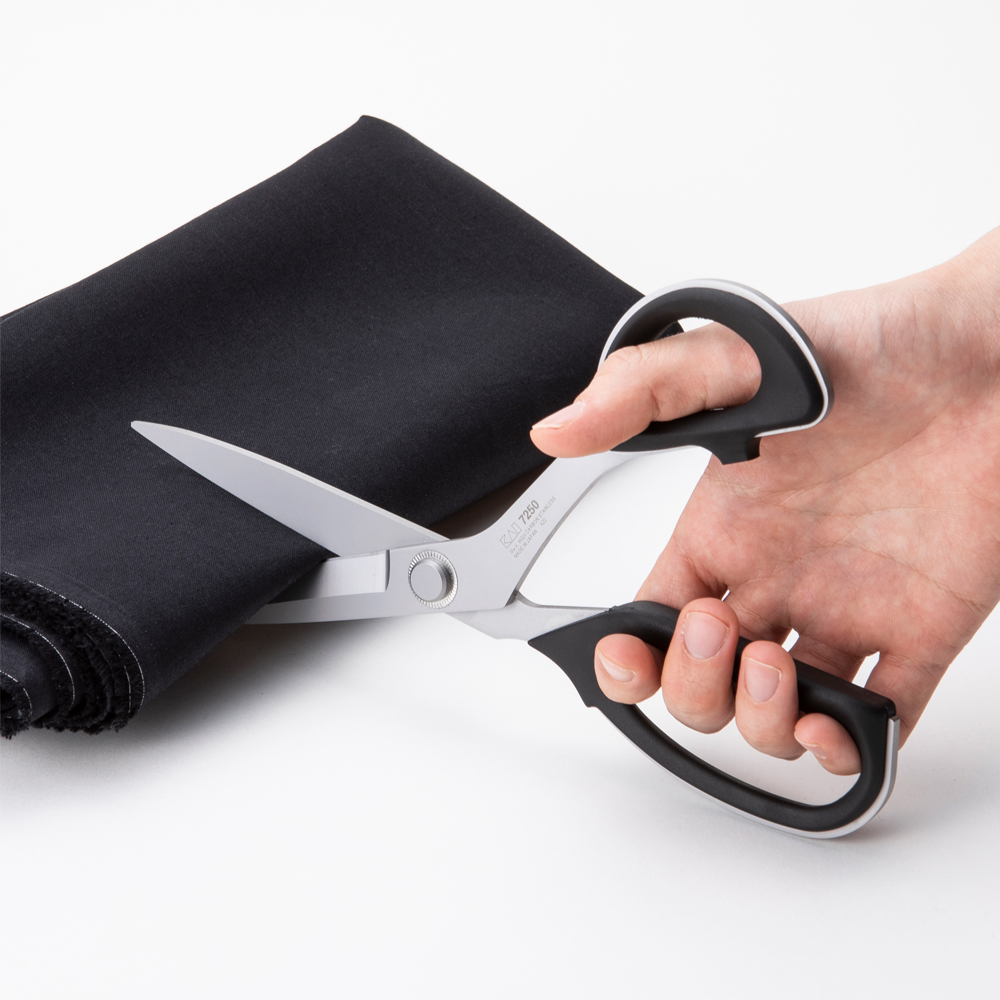
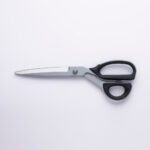
Look at the outline of the complete shears. The handle is offset from the cutting line, so your fingers do not have to sit directly underneath the blades as they enter the fabric. This is useful when cutting garment pieces laid flat on a table.
It does not mean the fabric remains perfectly motionless by itself. The lower blade still has to pass beneath the material, and the way you hold and move the shears affects how much the cloth lifts.
Bent handles and curved embroidery blades have different jobs
| Tool | Main question | Typical task to consider |
|---|---|---|
| Fabric shears with an offset handle | Can the hand move comfortably while the lower blade stays close to the table? | Cutting garment pieces from flat cloth |
| Small bent embroidery scissors | Can the fine tips approach the thread clearly? | Detailed embroidery trimming |
| Double-curved embroidery scissors | Can the handle clear a hoop while the tips reach the work? | Thread trimming inside an embroidery hoop |
A listing called “bent scissors” may describe a small embroidery tool. For example, the KAI Bent scissors are 100mm overall with a 25mm blade. They are a different size and application from the 25cm KAI fabric shears shown above. Compare the purpose as well as the name.
Set up a supported cutting area
Before cutting a long panel, gather or support the unused fabric so that its weight does not pull across the table edge. Smooth the section you are working on without stretching it. Arrange the pattern and its holding method before bringing the shears into place.
Keep the working area clear enough to move around the piece. A larger table is helpful only if the fabric can lie securely on it and you can reach the cutting line comfortably. If the cloth has already shifted, restore the layout before continuing.
Keep the cutting movement close to the table
- Place the flat lower side of the shears against the table and position yourself to see the cutting line.
- Use controlled strokes through an ordinary straight section, keeping the fabric flat.
- As the direction changes, adjust your position rather than twisting the fabric towards the tool.
- Use smaller movements around a curve, checking the line before each cut.
- Stop to move pins or weights out of the blade path. Keep the supporting hand clear of the blades.
For long edges, repeatedly closing right to the tips can leave small steps where cuts meet. Practise making smooth overlapping cuts on a scrap, reserving deliberate tip cuts for details that need them.
Choose a comfortable model
Handle fit, overall length and handedness still matter. Compare the Shozaburo 24cm right-handed shears with the KAI 25cm and 28cm options below. A similar length does not guarantee a similar grip, and a longer blade does not remove the need to reposition yourself.
If you want to compare sizes first, read Choosing the Length of Tailor’s Shears. For small curved tools, see Straight or Curved Embroidery Scissors?
Compare fabric shears
 Kai – Tailors Shears 25cm
 Shozaburo tailor shears 24cm (Right-handed)
 Kai – Tailors Shears 28cm