
Sewing Tips & Tool Advice
Choosing the Length of Tailor’s Shears
Eight Needles Journal · Scissors
The best length of tailor’s shears is the one you can open, guide and close comfortably through your usual fabric. Longer blades can help with long cutting lines, but the extra reach is useful only while the tool stays under control. Compare the handle and the job before choosing the largest size.
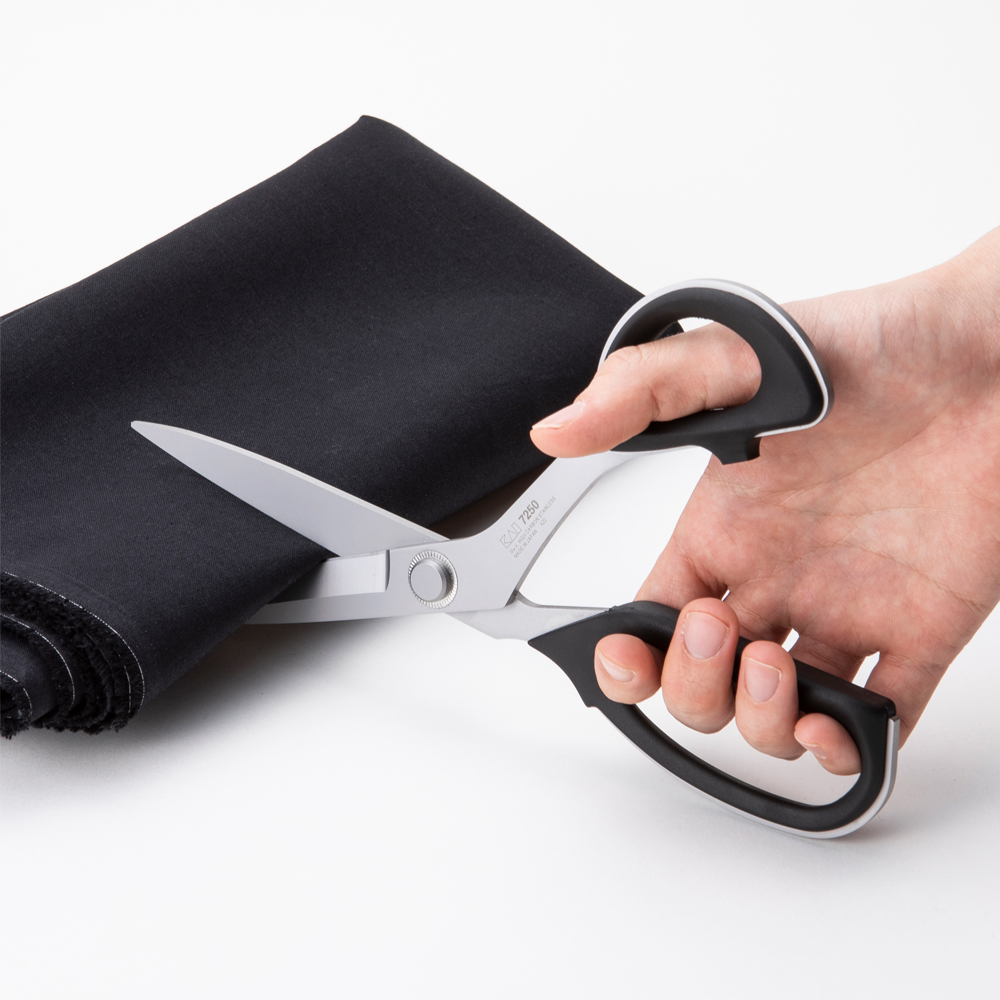
Compare five overall lengths
| Model to compare | Overall length | Useful question |
|---|---|---|
| Shozaburo tailor shears, right-handed | 24cm | Does this size give me comfortable control for my ordinary garment pieces? |
| KAI N7250 | 25cm | How does the different handle fit, compared with a similar-length pair? |
| Shozaburo tailor shears, right-handed | 26cm | Can I use the extra size without stretching my grip? |
| KAI N7280 | 28cm | Would longer cutting strokes help with the pieces I cut most often? |
| KAI N7300 | 30cm | Do I have the hand comfort and working space to guide this larger tool? |
These figures describe the complete scissors, including the handles. They are not blade lengths and do not tell you how much fabric each cut will cover. Nor does a one-centimetre difference establish that one brand is more comfortable than another.
Start with your current pair
If you already own fabric shears, measure their overall length and note what actually bothers you. Do your fingers feel cramped? Does the opening feel too wide? Are you making many short cuts along long edges, or is the tip awkward around small shapes?
That gives the next purchase a clear purpose. Replacing a 24cm pair with a 26cm pair will not necessarily solve a poorly fitting handle. Equally, a comfortable shorter pair may be more useful than a longer one that is tiring to open repeatedly.
Match the length to the pattern pieces
Long trouser legs, skirt panels and other extended edges give a longer blade room to work. Collars, facings and small shaped pieces call for frequent changes of direction. Think about the balance of those tasks across a normal project.
You do not have to complete every cut with the same tool. A manageable pair of fabric shears can do the main cutting, while smaller scissors handle an appropriate detail. Buying several nearly identical large pairs is less useful if the missing tool is actually one for close trimming.
Try the movement, not just the weight
- Hold the selected shears in the intended hand and check that the handle does not pinch your fingers.
- Open and close them slowly through a comfortable range. Notice whether you need to stretch or change your grip.
- With permission to test a pair, cut a spare piece of the fabric you normally use.
- Try both a straight section and a gentle curve. Keep the fabric supported and the free hand outside the blade path.
- Judge the ease of guiding several cuts, not only the first clean snip.
A new pair can feel different from a familiar one, but pain, forced opening and poor control are useful reasons to reconsider the fit. Overall length and a photograph cannot settle those questions for your hand.
Give the fabric enough support
Lay out the work so its weight does not pull it off the table while you cut. Move yourself around a large piece where possible, keeping the layout flat. Clear pins and other hard objects from the blade path before reaching them.
If fabric folds between the blades or the shears begin to catch, investigate their condition rather than choosing a longer pair as the automatic solution. Size, blade condition and fabric support are separate parts of a clean cut.
Related tools to compare
 Shozaburo tailor shears 24cm (Right-handed)
 Shozaburo tailor shears 26cm (Right-handed)
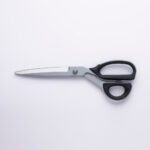 Kai – Tailors Shears 28cm
Also compare KAI 25cm shears and KAI 30cm shears.
