
Sewing Tips & Tool Advice
Patchwork and Quilting Needles: Read the Application
Eight Needles Journal · Needles
Patchwork joins pieces; quilting stitches through the layered quilt. Those tasks can favour different needle dimensions and handling. A packet labelled for one job is a useful starting point, but the fabric and thread still need a practical check.

Start with the stage of the quilt
Piecing joins separate patches into the quilt top. Quilting carries stitches through the top, wadding and backing. Basting temporarily holds the layers together, while appliqué attaches shapes to a background. These jobs do not all call for the same reach, point control or stitch size.
For hand piecing, look for a sharp point and a length you can guide accurately along the seam. For hand quilting, a shorter needle is often easier to control through the layered sandwich. Do not choose solely by the word “quilt” on a packet: read the specific application.
Six Misuya Chubei options compared
| Needle | Length | Thickness | Packet |
|---|---|---|---|
| Patchwork — short | 28.8 mm | 0.51 mm | 25 |
| Patchwork — regular | 36.4 mm | 0.56 mm | 25 |
| Patchwork — long | 42.4 mm | 0.56 mm | 25 |
| Quilting — fine | 23.8 mm | 0.51 mm | 15 |
| Quilting — regular | 25.8 mm | 0.53 mm | 15 |
| Quilting — thick | 28.8 mm | 0.60 mm | 15 |
Each packet contains the selected needle, rather than all three sizes. These are grooved-eye needles. Notice that short patchwork and thick quilting needles share a 28.8 mm length but have different thicknesses. The regular and long patchwork needles, by contrast, have the same thickness and different lengths.
Test piecing at a seam intersection
Start with two scraps of the project fabric and sew along a marked seam. Check whether the point comes out where you intend and whether you can maintain the seam allowance without stretching the edge.
Next, try an intersection where several seam allowances meet. This is often the more demanding part of the block. If the needle struggles only there, check the direction and bulk of the allowances before changing the needle for the whole quilt. Do not force a fine needle through a dense stack.
Test quilting through all three layers
Make a small sandwich with the actual top fabric, wadding and backing. Use the same thread, basting method and hoop arrangement planned for the quilt. A trial through the top alone leaves out most of the work the needle will do.
Work a short line and inspect both sides. The stitches should catch the backing as intended, and the thread should pull through without repeated snagging. Begin with a manageable number of stitches on the needle. Consistent placement matters more than loading as many stitches as possible.
Choose a comfortable size, then keep it identifiable
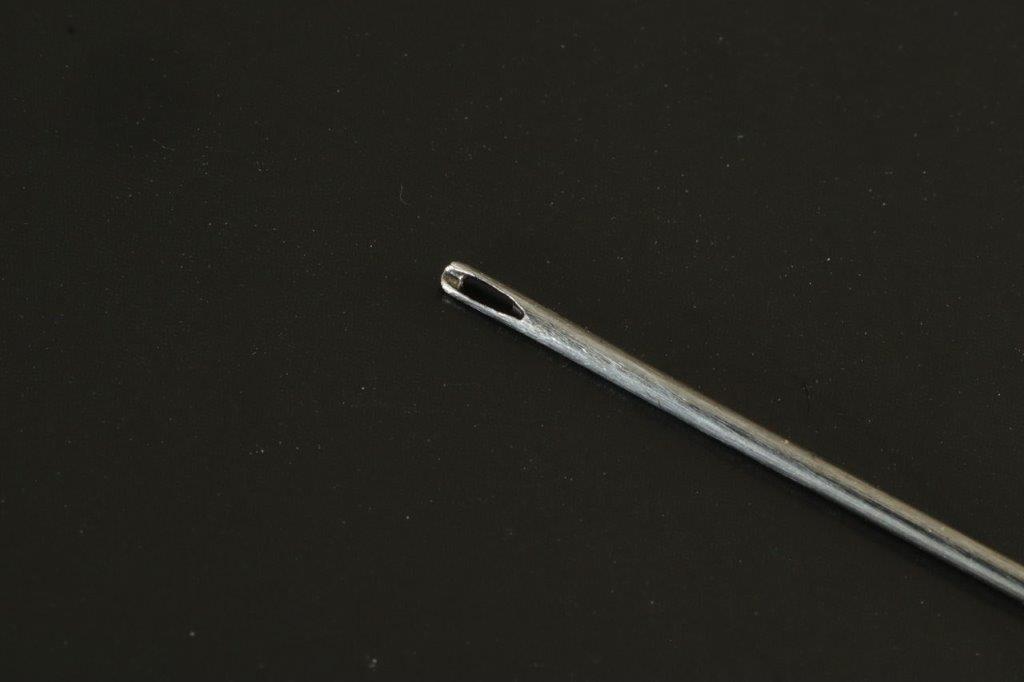
A very short quilting needle can feel awkward at first. Compare adjacent sizes using the same sandwich, thread and thimble so you can tell which change helped. If the eye is difficult to thread, check the thread and any threader for compatibility; forcing a threader through a small eye can damage both.
Keep piecing and quilting needles in their labelled packets. When one works particularly well, note the size with the thread and wadding details. Your next quilt may use different materials, so the note is a starting point for the next trial, not a universal rule.
Compare patchwork needles · Compare quilting needles · Quilting and patchwork assortment
