
Sewing Tips & Tool Advice
Paper and Fabric Cutting: Organising Separate Tools
Eight Needles Journal · Rotary cutting
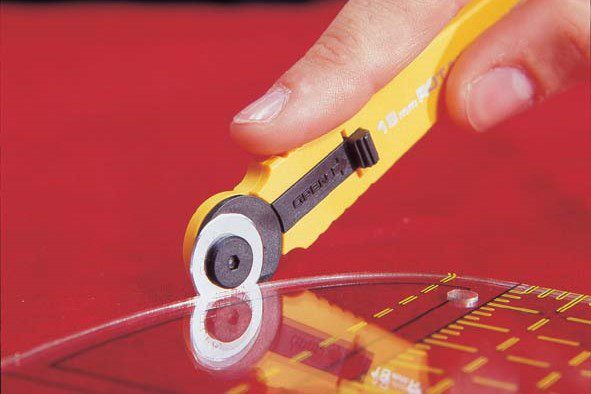
A paper pattern and a length of fabric may share the same table, but it helps to give their cutting tools clear jobs. A simple paper pair and a dependable fabric cutter can make a more useful kit than several unlabelled blades.
Choose a role for each cutting tool
| Task | Tool to consider | What to check |
|---|---|---|
| Trim a printed sewing pattern | General-purpose paper scissors or a suitable craft knife | Remove staples; use a mat and cutting guide with a knife |
| Cut garment pieces | Fabric shears or a smooth rotary cutter | A clean sample cut through the planned fabric layers |
| Make a tear-off paper section | A perforation cutter | The paper stays joined until torn |
| Snip sewing threads | Thread snips or small sewing scissors | Controlled access to the thread, clear of the cloth |
| Open packaging or cut adhesive tape | A suitable general-purpose tool | Keep adhesive residue away from the fabric-cutting setup |
Does touching paper ruin a rotary blade?
No universal rule makes one paper cut an automatic disaster. For example, the OLFA RTY-1/C is designed for paper as well as cloth and other sheet materials. That is different from saying every blade should be shared for every task.
Separating tools is a practical way to keep track of wear, dirt and adhesive. It also means the cutter you reach for before cutting a garment has a known recent history. Follow each tool’s material limits: some fabric shears are intended specifically for cloth, while other cutting tools cover a broader range.
If a fabric cutter has been used on paper, inspect it and make a scrap cut before deciding what to do. If it still works cleanly and its use was within the model’s limits, the paper contact alone is not a reason to discard it. A damaged, dragging or unreliable edge does need attention.
Three workable ways to organise a small kit
One rotary cutter, separate paper scissors: this is a straightforward starting point. Prepare the paper pattern with the scissors, clear the table, then use the rotary cutter for fabric. You avoid buying a second handle and avoid routine blade swaps.
Two labelled rotary cutters: useful when you repeatedly cut both paper and fabric with a wheel. Mark the handles “paper” and “fabric” where the label will not obstruct the grip, blade cover or controls. Different handle colours can help, but a written label is clearer in a shared room.
One handle with labelled spare blades: possible with compatible replacements, but less convenient if you change jobs frequently. Every swap requires the correct procedure and secure storage. Never keep loose circular blades in a pouch, and do not mix a used blade into a packet of new ones.
Reset the table between stages
Finish taping and trimming the pattern before spreading valuable fabric. Remove paper scraps, pins, staples and exposed adhesive. Check the ruler’s cutting edge and the mat surface, then arrange the cloth without letting its weight pull from the table.
When cutting around paper, confirm whether the pattern edge already includes seam allowance. An accurately trimmed stitching line is still the wrong cutting edge if the allowance has not been added. Keep the paper in position without putting weights or pins in the blade’s route.
Keep the spare useful
Write the cutter model on its refill packet and check the blade code, diameter and edge type when ordering. The smooth RB28 family and perforating PRB28 family do different jobs despite sharing a diameter. A cutter reserved for paper still needs a sound blade; it is not a destination for chipped or unsafe replacements.
Before starting the garment, make a short cut on spare fabric. If threads remain joined, stop and check the blade, mat and number of layers. Pressing harder should not become the routine that hides a tool problem.
Tools for different jobs
The perforation cutter below is for interrupted cuts; the 45mm smooth rotary cutter and 24cm shears are options to compare for fabric cutting.
 Olfa Perforation Rotary Cutter 28mm
 Olfa Rotary Cutter 45mm with Special Endurance Blade (RTY-2/G + RB45H-1)
 Shozaburo tailor shears 24cm (Right-handed)