
Sewing Tips & Tool Advice
Perforation Cutter or Standard Rotary Cutter?
Eight Needles Journal · Rotary cutting
Choose a smooth rotary blade to separate fabric. Choose a perforation blade when paper should stay connected until someone tears it off. Both tools roll, but the finished edge is different—and that difference matters more than the shape of the handle.
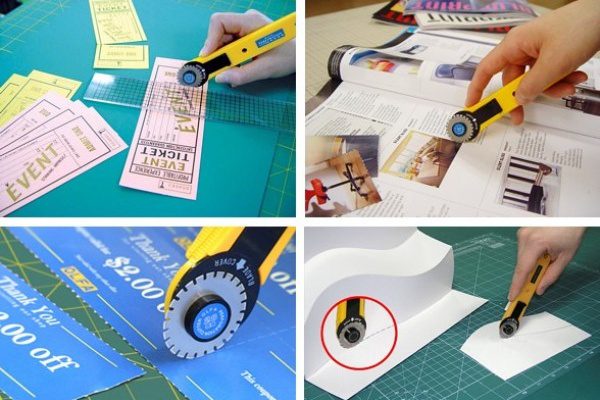
Four tools that leave different marks
| Tool | Result | A useful task |
|---|---|---|
| Smooth rotary cutter | One continuous cut | Cutting fabric pieces or trimming paper |
| Perforation cutter | Short cuts separated by uncut bridges | Tear-off tickets, coupons and paper craft |
| Tracing wheel | A traced or indented line, depending on the wheel and transfer system | Transferring pattern information |
| Scoring tool or bone folder | A crease without an intended cut | Folding a card while keeping its hinge intact |
A toothed tracing wheel and a perforating blade can look similar at a glance. Check what the tool is designed to do. A paper fold that must remain strong needs a crease; a tear-off section needs deliberate breaks. Do not use a cutting blade to mark a stitching line in fabric you want to keep intact.
Compare the OLFA models and their cuts
The 28mm PRC-3/C makes cut sections of approximately 2.7mm with 1mm left uncut between them. The 18mm PRC-2 uses approximately 6mm cut sections with 1mm bridges. A smaller wheel therefore does not automatically mean finer perforations.
The ordinary 28mm RTY-1/C and 18mm RTY-4 arrive with smooth cutting blades. For garment cutting, those continuous edges are the relevant choice. A deliberately perforated line in a paper project is useful; the same interrupted line in a garment cutting layout leaves work unfinished.
Check the blade code when changing the function
| Body | Smooth blade family | Perforation blade family |
|---|---|---|
| OLFA RTY-1/C or PRC-3/C, 28mm | RB28 | PRB28 |
| OLFA RTY-4 or PRC-2, 18mm | RB18 | PRB18 |
The RB28-2 packet contains two smooth blades; PRB28-2 contains two perforation blades. Replacing the blade changes the work the cutter performs. Keep the packet and label the handle if you use otherwise similar bodies for different jobs. These matches do not establish compatibility with every other 18mm or 28mm cutter.
Make a tear test before making a batch
Use an offcut of the actual paper, including any printing or coating. Lay it on a suitable cutting mat, keep fingers clear and make a short line with a stable cutting guide where needed. Cover the blade before lifting the sample.
Look at both sides, then tear the sample in the direction it will be used. Does it stay together while handled? Does it separate along the intended line? A visible dotted line alone does not answer either question. Thick card, thin paper and coated stock can behave differently, so a result on ordinary printer paper does not settle the choice for all three.
If the paper pulls apart too soon, check whether a smooth blade has been fitted or a second pass has cut through the bridges. If it will not tear cleanly, check the paper, blade condition and working surface before pressing harder. Repeated passes can land between the first cuts and change the result.
Keep cutting and marking tools easy to recognise
Store spare blades in their protective cases, with the code visible. Close the cutter’s cover whenever setting it down, including while repositioning paper. Follow the exact body’s changing instructions; never change a blade in the palm of your hand.
For most sewing kits, a smooth rotary cutter comes first. A perforation cutter earns its place when tear-off paper work is a recurring task. It is an additional function, rather than an upgrade in fabric-cutting ability.
Compare the two 28mm cutters
 Olfa Perforation Rotary Cutter 28mm
 Olfa Rotary Cutter 28mm RTY-1/ C
For replacement codes and pack quantities, see Buying the Correct Rotary-Cutter Replacement Blade.
