
Sewing Tips & Tool Advice
Buying the Correct Rotary-Cutter Replacement Blade
Eight Needles Journal · Cutting
A replacement rotary blade is a small purchase with several details worth getting right: the cutter model, the blade diameter, the cutting edge and the number in the packet. Keeping a suitable spare is useful, but buying a larger blade does not upgrade a smaller cutter.

The spare we would keep with the cutter
A labelled spare blade is a small addition that can save an interrupted sewing session. We would keep the correct replacement with the cutter we use most, rather than buying several sizes without checking the bodies already in the sewing box.
Choose around your actual routine. If most projects involve one cutter, start with its matching refill. If you alternate between two sizes, label both packets clearly. A spare for a different diameter will not help when the blade you need becomes worn.
Compare the diameter, model and packet contents
| Replacement blade | Contents | Confirmed matching body |
|---|---|---|
| OLFA RB18-2 | Two 18mm smooth blades | OLFA RTY-4 |
| OLFA RB28-2 | Two 28mm smooth circular blades | OLFA RTY-1/C and PRC-3/C |
| OLFA RB45H-1 Endurance | One 45mm blade | OLFA RTY-2/G; check the full model when using another body |
| Clover 57-504 | Two 28mm blades with holders | Clover 28mm rotary cutter 57-502; also designed for the Clover Slash Cutter |
| Clover 57-503 | One 45mm blade with holder | Clover 45mm rotary cutter 57-500; also fits the 57-499 standing thread cutter |
Diameter alone is not a compatibility guarantee. Match the full cutter model and replacement code, then check the quantity. Clover’s 28mm and 45mm refills have different blade counts; RB28-10 is also a different purchase from RB28-2. A holder supplied with a refill is part of its intended changing system, so do not assume another brand’s bare blade gives the same handling arrangement.
The same diameter can produce a different edge
A smooth rotary blade separates the material continuously. A perforation blade deliberately leaves small connections so a piece can be torn away later. Both RB28 smooth blades and PRB28 perforation blades fit the OLFA PRC-3/C. Fitting the smooth RB28 therefore changes the cut it makes; it does not replace a worn perforation edge with an identical one. Check the letters on the packet as well as “28mm”. See our perforation and rotary-cutter comparison before choosing between the two tasks.
Why an old tutorial may show different parts
Check the back of your cutter before following a replacement tutorial. OLFA has made both screw-fastened and quick-change arrangements. A photograph of an older body may show parts that do not belong to yours, even when the cutting diameter is the same.
The practical point for replacement is that two OLFA cutters need not come apart in the same way. Do not transplant washers, tighten with pliers or copy a screw-adjustment tutorial onto a quick-change model. Use the instructions supplied with your exact body. If a correctly installed blade still moves abnormally, stop using it and check with the manufacturer.
Endurance is a comparison, not a replacement calendar
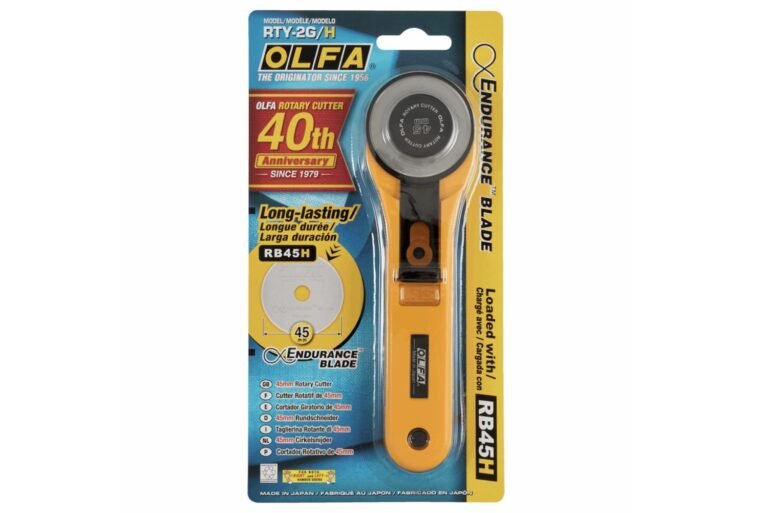
The RB45H Endurance blade is designed to last longer than the standard RB45. That does not give every sewer the same number of projects or months between changes. Avoid translating a durability claim into a fixed promise about your fabric, cutting surface or technique. If the cutter leaves connected threads, examine the tool and working setup before simply pressing harder.
When a new blade does not turn normally
Stop before cutting your project. With multi-packs, two thin blades can stick together: the body must receive only the number specified in its instructions, normally one. Do not feel around an exposed rim to check. Use the model’s blade-changing procedure and protective case or supplied holder. A loose washer, trapped debris or incorrect assembly also needs checking; forcing the wheel through fabric will not correct the installation.
A small, useful spare-blade routine
Keep the original packet with the cutter’s model written on it. Store unused blades in their protective case, separate from loose pins and other tools. Follow the body’s instructions when changing a blade, cover it whenever the cutter is set down, and do a short trial cut on a suitable mat before returning to your project. A replacement should restore the tool’s intended operation; an unexpectedly loose, stiff or damaged assembly needs attention.
If you are choosing a complete cutter, our 18mm, 28mm and 45mm guide compares the actual models and explains the different cover mechanisms. For an existing RTY-1/C, the matching smooth spare listed above is RB28-2.
