
Sewing Tips & Tool Advice
18mm, 28mm or 45mm Rotary Cutter?
Eight Needles Journal · Cutting
For small, detailed shapes, start by comparing 18mm and 28mm rotary cutters. For a mixture of garment pieces and straight strips, add a 45mm model to the shortlist. The number is the blade’s diameter, not a rating of sharpness or a promise about how many layers it will cut.
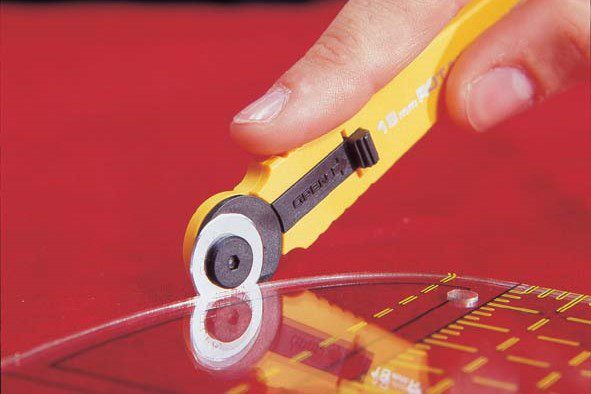
Compare four sizes by the work they need to do
| Blade diameter | A useful starting point | The compromise to consider |
|---|---|---|
| 18mm | Detailed outlines, small craft pieces and tighter curves. | A small head is useful for access; it does not make a heavy stack suitable. |
| 28mm | Small sewing projects, curved pattern pieces and everyday work where visibility matters. | Compare its grip with 45mm if your projects involve many long straight cuts. |
| 45mm | Garment cutting, patchwork strips and a mix of straight and gently curved edges. | Very small corners may still be easier to finish with suitable scissors. |
| 60mm | Larger pieces and appropriate thicker or layered materials. | The larger head takes more room; it is not an automatic upgrade for intricate work. |
There is no single best first diameter for every sewer. Someone making doll clothes and someone cutting broad panels have different reasons to choose. Look at the smallest curve and the longest uninterrupted cut in the projects you actually make.
The three OLFA cutters in our range
| Model | Size | Distinguishing feature |
|---|---|---|
| RTY-4 | 18mm | Compact hobby cutter with a sliding blade cover; RB18 is the standard replacement blade. |
| RTY-1/C | 28mm | Quick-change rear clasp; takes RB28 cutting blades and the separately sold PRB28 perforation blade. |
| RTY-2/G Endurance version | 45mm | Straight handle with a manually operated cover; this listing includes the Endurance blade. |
All three bodies accommodate right- and left-handed users. Follow the setup and blade-change instructions for the exact body. A procedure for the RTY-1/C’s clasp is not the assembly sequence for the RTY-2/G.
The 18mm RTY-4 deserves a look if a larger cutter obscures an awkward outline. The 28mm RTY-1/C offers a larger wheel while remaining compact. Neither requires you to replace a pair of shears that already works well for the rest of your project.
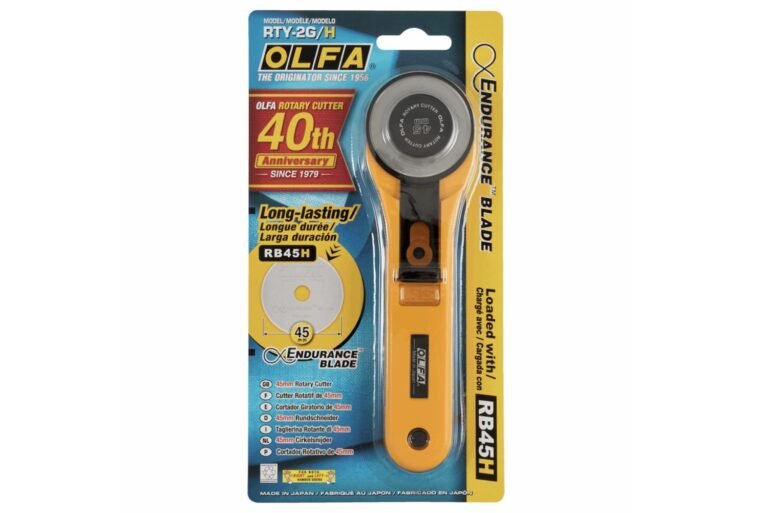
Same diameter, different controls
A 45mm comparison becomes more useful when you include the mechanism around the blade. These examples show why the brand and size alone are not enough:
- OLFA RTY-2/G: you slide the cover to expose and protect the edge.
- Clover 57-500, 45mm: a shaped handle with an elastomer component and adjustable rotational resistance; the left-handed setup needs attention.
- OLFA Safety Rotary Cutter L, 156B: the grip-operated mechanism exposes the blade when squeezed.
- KAI 45mm safety rotary cutter: pressure against the cutting surface moves the protective guard; it returns when that pressure is released.
These are different actions. A pressure-operated guard is not the same as a squeeze handle, and neither describes every cutter sold by that brand. Compare how naturally you can operate the control and see the point where the edge meets the fabric. Do not assume that a tool described as a safety cutter cannot cause a cut.
What does an Endurance blade change?
The 45mm Endurance version concerns the fitted blade, not a larger cutting diameter. It is a longer-wearing option within the compatible 45mm system. The name does not establish a fixed number of projects between replacements, and a damaged edge still needs attention.
Make the comparison on a useful sample
Try a straight line and the most demanding curve on spare fabric of the type you plan to cut, using a suitable mat. Can you keep the blade upright, see the line and guide the tool without leaning awkwardly? Is the result clean through the intended layers?
For a fair comparison, do not judge a worn blade against a fresh one. Keep the material, layer count and surface the same. Stop if the tool skips, wobbles or needs excessive force; investigate the blade, assembly and mat before choosing a bigger diameter.
Keep your free hand out of the cutting path and close the cover whenever you pause. The three OLFA models in our range use covers you operate yourself; placing them on the table does not automatically cover the edge.
