
Sewing Tips & Tool Advice
Choosing a Cutting Mat for Sewing Projects
Eight Needles Journal · Rotary cutting
Choose a cutting mat by the space your pattern pieces need, the table that will support it and the place you will store it. A large surface can reduce repositioning, but only if you can lay it flat and reach the work comfortably.
Compare the actual dimensions
| Mat | Open size | Format to consider |
|---|---|---|
| OLFA A1, 160B | 90 × 62cm | Flat mat, 2mm thick; both sides can be used. |
| OLFA A2, 159B | 62 × 45cm | Flat mat for a smaller work surface. |
| Clover Cutting Mat e A1 Folding, 57-859 | 90 × 60cm | Folds to 45.5 × 60cm; open thickness 2.5mm. |
| Clover Cutting Mat e A3W Folding, 57-858 | 90 × 32cm | Long, narrow format; folds to 45.5 × 32cm. |
| Clover Cutting Mat e A2 Nobi, 57-855 | 64 × 45cm | Flat format with extra width compared with the OLFA A2 above. |
| Clover Cutting Mat e B5 Folding, 57-857 | 29 × 18cm including ruler pocket | Actual mat area 26 × 18cm; folds to 15 × 18cm and includes a 15cm ruler. |
The names A1, A2 and B5 are useful categories, but they are not a substitute for the product dimensions. The ruler pocket on the compact Clover mat is a good example: the total open size is larger than the cutting area.
What fits the projects you make?
Lay out the largest pattern piece from a typical project and measure its cutting route, including seam allowances where required. A pocket or small pouch needs a different area from a trouser leg. Even an A1 mat may not support a long garment piece in one position.
The long, narrow A3W format is worth comparing for straps and other narrow pieces. Its 90cm length does not give it the same working area as a 90 × 60cm mat. For small portable projects, the B5 format saves space but still needs a stable surface beneath it.
Folding helps storage, not table size
A folding mat can be useful when the cutting table must be cleared after sewing. Open it as designed and check that the joint lies level before cutting. A conventional flat mat should not be folded or rolled to imitate it.
Measure your storage space before buying. The Clover A1 folding mat needs 45.5 × 60cm when closed, which is still a substantial object. These Clover mats should be stored flat; leaning them against furniture is not the recommended storage method.
Check which surface is intended for cutting
The OLFA A1 160B can be used on both its grey and brown sides. Do not extend that rule to every two-colour mat: the Clover folding e models in this comparison specify that the reverse should not be used.
Use the printed grid as a positioning aid. When an exact strip width matters, measure consistently with a suitable ruler. Temperature and storage conditions can affect a mat, so a printed grid should not be treated as an infallible measuring standard.
A good surface needs care
Keep the mat away from irons, hot cups, heaters, hot vehicles and direct sunlight. A rotary-cutting mat is not a pressing mat. Avoid strong solvent cleaning; for the Clover e models, use a damp cloth for ordinary dirt.
Check for grooves, distortion or damage that affects the blade’s movement. If a cut repeatedly fails at the same place on the surface, try a clean, undamaged area with suitable scrap material before blaming the cutter alone. Do not attempt to flatten a warped mat with an iron.
Complete the cutting area
A mat supports the blade; a cutting ruler guides straight lines; pattern weights help hold the layout. None replaces the others. Keep fabric hanging from the table from pulling on the part being cut, and keep the entire blade route on the protected surface.
If your space cannot support the required mat, suitable fabric shears may be the more practical choice for that project. Choose the complete working arrangement before buying another cutting tool.
Tools to use alongside a mat
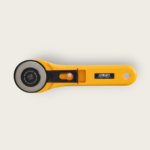 Olfa Rotary Cutter 45mm with Special Endurance Blade (RTY-2/G + RB45H-1)
 Kawaguchi 30cm Cutting Ruler
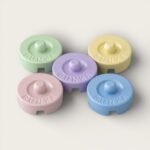 Bunka Pattern/Fabric Weight – Gelato Pastels in 5 options