
No products in the basket.
Guides
18mm, 28mm or 45mm Rotary Cutter?
Eight Needles Journal · Cutting
We would start with the shapes you cut most often: small curved pieces, everyday dressmaking or longer straight runs. The best choice is the cutter you can guide comfortably while keeping the line in view. Here is how we would compare the three OLFA models in our range.
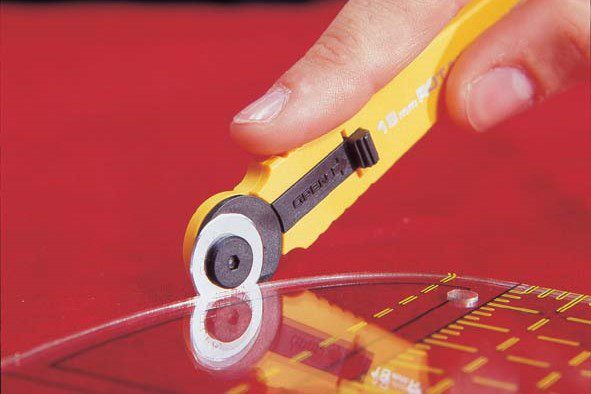
Our starting point: the work on your table
For small pieces and detailed curves, we would put the 18mm and 28mm options side by side first. For longer straight cuts, include the 45mm in that comparison. Think about the whole project: a larger garment can still contain little corners that you prefer to finish with scissors.
We would not choose a cutter from diameter alone. Your grip, the cutting surface and the shape of the piece all affect how manageable the job feels. A useful first tool should suit the work you actually make, rather than an imagined future project.
The three models in this comparison
| Model | Blade diameter | What distinguishes this listing |
|---|---|---|
| RTY-4 | 18mm | Compact hobby rotary cutter; OLFA lists an RB18 replacement blade |
| RTY-1/C | 28mm | Quick blade-change clasp; OLFA lists RB28 and optional PRB28 perforation blades |
| RTY-2/G with RB45H-1 | 45mm | Our Endurance-blade version of the straight-handle cutter |
OLFA identifies all three bodies as suitable for right- and left-handed users. The controls and blade-change arrangements are model-specific: use the instructions for RTY-4, RTY-1/C or RTY-2/G, rather than transferring a procedure from another cutter.
18mm: a small tool to consider for detailed shapes
OLFA describes the RTY-4 as a hobby cutter with an 18mm stainless-steel blade, capable of straight and curved cuts. The blade cover slides back to expose the edge and must cover it again when you stop. The manufacturer’s illustrated blade-change sequence uses the rear clasp and specifies that the operation must not be carried out in the palm of your hand.
Look at the tightest shape in your pattern before choosing the RTY-4. We like the idea of keeping a small cutter for detailed work alongside the tool used for longer cuts. Try the awkward part on scrap cloth before approaching the finished piece.
28mm: a middle size with its own blade system
The RTY-1/C is the 28mm quick-change model. OLFA specifies a sliding cover, a rear blade-release clasp and use on a cutting mat. The manufacturer also lists a separately sold perforating blade for this body. A perforated line and a continuous cut are different outcomes, so check the blade as well as the handle when comparing listings.
45mm: check which blade is included
Our RTY-2/G listing is specifically the version with an Endurance blade. OLFA’s RB45H-1 specification confirms compatibility with this body and describes longer-lasting sharpness than the standard RB45. That is a manufacturer comparison, not a fixed replacement interval for every project.
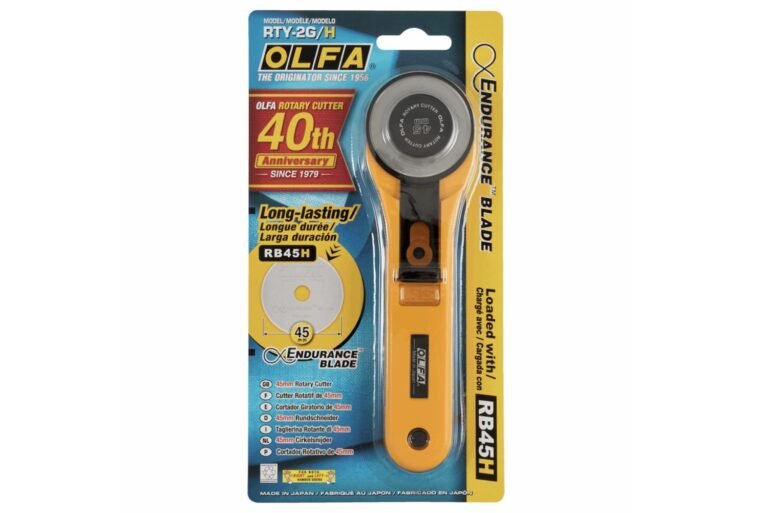
Look beyond the diameter
The handle, central fixing and blade cover deserve a close look. Can you see where the edge meets the cloth? Can you reach the cover without an awkward change of grip? Two cutters with a 45mm blade can feel quite different because the body around that blade is different.
Our recommendation is to compare the entire tool. A manual sliding cover and a squeeze-to-expose mechanism involve different movements. The three OLFA bodies listed here use covers you operate yourself; choose with that everyday action in mind.
Watch OLFA’s RTY-1/C demonstration
The following video is embedded on OLFA’s official RTY-1/C product page. Refer to that model’s illustrated instructions for the blade-change procedure.
From comparison to your cutting table
Use a cutting mat, keep fingers clear of the blade and close the cover when the tool is not in use, as OLFA instructs. For the models described here, the cover is something you operate; do not assume the blade retracts automatically when you put the cutter down.
Compare the 18mm RTY-4, 28mm RTY-1/C and 45mm RTY-2/G Endurance version. Check availability and included parts on the individual product page.
A short piece of OLFA history
OLFA’s company timeline distinguishes the 1956 invention of the snap-off knife by Yoshio Okada, the 1967 establishment of Okada Kogyo in Osaka, and the rotary cutter’s invention in 1979 followed by launch in February 1980. These are different milestones in the company’s history.
Explore the Eight Needles Journal
Sources and further reading
Product information and background reading used in preparing this guide.
