
Sewing Tips & Tool Advice
Sharp, Smooth and Ball-Point Awls: Choosing the Tip
Eight Needles Journal · Punching & finishing
Choose an awl by what its tip must do: enter a tiny space, separate a weave, guide cloth or arrange a corner. Sharp, smooth and ball-point tips solve different problems. A comfortable handle matters, but it cannot change the action of the point.
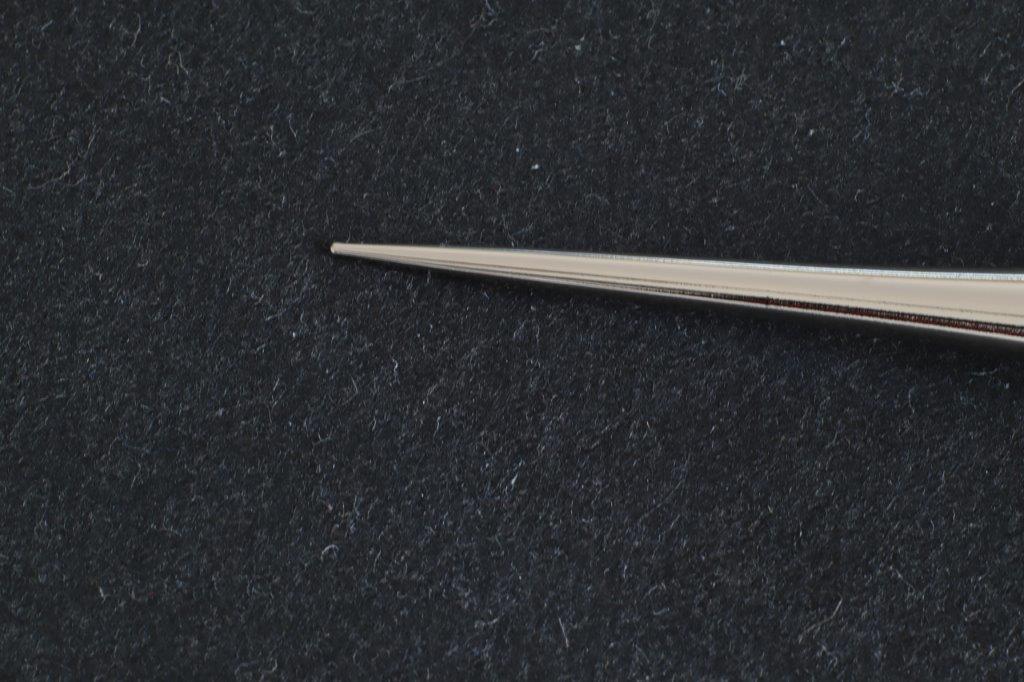
Compare five useful tip designs
| Design | Where it helps | Selection point |
|---|---|---|
| Sharp sewing awl | Precise access and piercing where the construction requires it | The point can catch or damage fabric; avoid forcing it into a turned corner. |
| Smooth sewing awl | Guiding fabric and making small shaping adjustments | A rounded tip reduces the sharpness of contact, but does not make force harmless. |
| Ball-point awl | Opening the weave for boutis or trapunto | It separates threads rather than cutting out a circular disc. |
| Curved smooth awl | Reaching around an edge and shaping with the back of the curve | Check which part of the curve is intended to contact the work. |
| Fine awl with a slender shaft | Very small openings and detailed work | Look at shaft shape as well as tip sharpness. |
Clover’s Fine Awl 21-121 has a shaft designed to remain narrow towards the base, helping it reach into a small opening without widening it in the same way as a strongly tapered shaft. Clover’s Curved Awl 21-241 is used for feeding fabric, unpicking stitches and turning corners. The back of its curve also helps tuck fabric and paper cord into a purse frame. These are specific designs; not every product called a fine or curved awl has identical geometry.
Sharp versus smooth: start with your usual task
If you frequently need to lift a small thread or enter a tight space, a fine point may be easier to position. For guiding cloth or easing a seam into shape, a smooth end may be more suitable. Compare them on a scrap of the material you actually use. A preference formed on firm cotton may change when you work with loose weaves or delicate lining.
When unpicking, an awl can help lift already-cut threads. A seam ripper provides the cutting edge. Trying to tear every stitch out with an awl can strain the surrounding fabric.
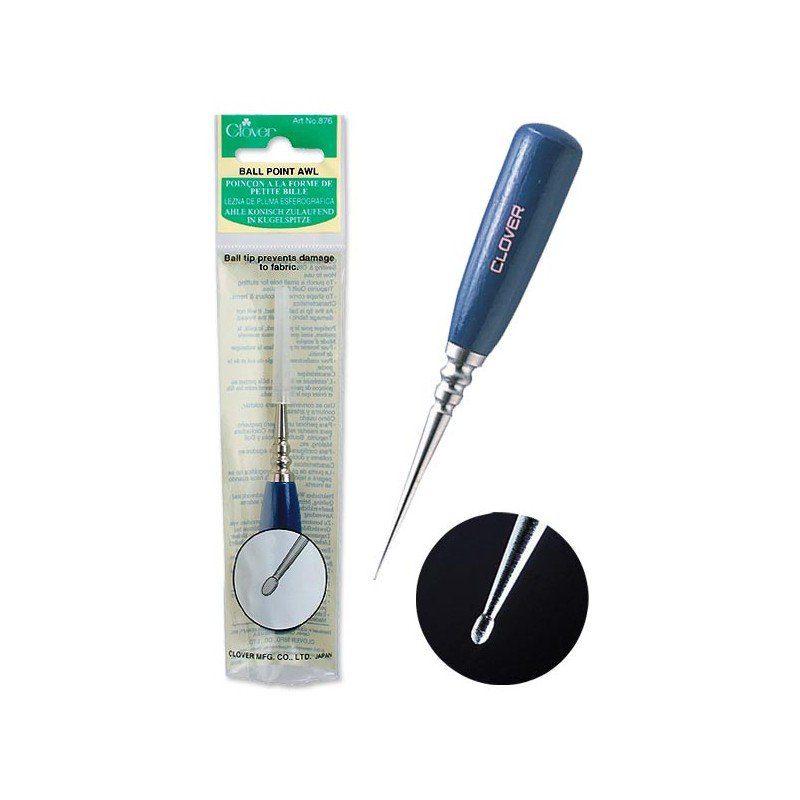
A ball-point awl is not an eyelet punch
For boutis and trapunto, the aim can be to move woven threads apart and later settle them back into position. A cutting punch removes material to make a hole. Before choosing either, decide whether your project needs a temporary opening in the weave or a cut opening for hardware. Also check any reinforcement and separate setting tools the hardware requires.
Compare the grip and cover too
Hold the tool as you would for detailed work. Can you see the tip clearly? Does the handle feel secure without a tight grip? A large handle may feel comfortable for one task but obstruct another. Check whether it rolls on your work surface and whether its cover remains secure in your sewing kit.
Inspect the metal for roughness or damage. Stop using a tip that snags a test scrap. A rough edge is not a feature to compensate for by pushing harder.
Keep the right point easy to recognise
Similar handles can conceal different tips. Keep covers fitted and label the storage position or handle where necessary. At the machine, stop the needle before repositioning a tool near the stitching area, and keep metal clear of the needle’s path.
Three tip types to compare
Compare the sharp Bunka awl, smooth Clover awl and Clover ball-point awl according to the task above.
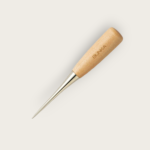 Bunka Sewing Awl (Sharp Edge)
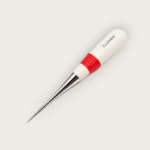 Clover Sewing Awl (Smooth Edge)
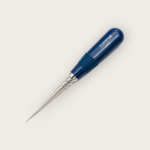 Clover Ball Point Awl