
Sewing Tips & Tool Advice
Half-Scale Pattern Rulers: Study Tools, Not Full-Size Patterns
Eight Needles Journal · Patternmaking
Half-scale work makes drafting exercises manageable on a small sheet. A half-scale ruler helps read reduced measurements, but the finished exercise is still a reduced pattern. Keep scale information prominent so it cannot be mistaken for a cutting pattern.

Read the number without reducing it twice
At half scale, a full-size length of 20cm occupies 10cm on the paper. A correctly graduated half-scale ruler does that conversion in its spacing: use its 20 mark to draw the reduced 20cm dimension. If you halve the number to 10 and then use the half-scale ruler, you reduce the length twice.
| Full-size dimension | Physical length at half scale | Reading on a half-scale ruler |
|---|---|---|
| 10cm | 5cm | 10 |
| 20cm | 10cm | 20 |
| 60cm | 30cm | 60 |
Check the ruler’s scale label before using this convention. An ordinary short ruler is still full scale: a regular 20cm ruler measures 20cm of physical length, not a reduced 40cm dimension.
Choose one scale convention
Follow the instructions supplied with the ruler and the exercise. Label the paper clearly before drawing. Do not combine full-size ruler readings with reduced-scale readings unless the conversion is deliberate and recorded.
What the three tools contribute
The Bunka set’s straight ruler shows a 60cm scale over an actual 30cm length. Its L ruler shows 35cm over 17.5cm, and the D curve is half size. Use the straight and L edges for the construction framework and the curve for suitable short sections. Having all three in the same scale helps avoid accidental mixing.
Angles do not halve with the lengths. A 90-degree corner remains 90 degrees, and a 45-degree direction remains 45 degrees. Use a protractor normally when the exercise specifies an angle.
Use the small format to study relationships
Reduced work can make it easier to compare angles, curves and construction steps. Keep lines fine enough that their thickness does not overwhelm small details. The exercise is about understanding the drafting process, not proving that a garment will fit.
Seam allowances need an explicit decision
If an exercise represents a 1cm full-size seam allowance at exact half scale, it is 5mm wide on the paper. A tutor may choose a different allowance for a small sewn sample so it is manageable to stitch. Label that exception; do not assume every dimension in a study sample has been reduced in the same way.
Keep the ruler set and all reduced pieces in a clearly marked folder. Fine lines and a short note beside each alteration are more useful than relying on the size of the paper to reveal its scale.
Return to full size carefully
When preparing a wearable pattern, use the full-size drafting method or a controlled enlargement process with reference checks. Check important dimensions independently. A larger photocopy without a scale check can preserve a mistake as easily as a correct line.
A practical example
A half-scale exercise uses a reduced ruler reading. Label the paper HALF SCALE before drawing. If you later enlarge it, verify a known dimension in both directions. A print or photocopy can change scale, and an unlabelled reduced pattern can easily be mistaken for a full-size piece.
Check before choosing
- Is the scale written on every piece?
- Am I mixing ruler scales?
- Have full-size dimensions been checked?
Related tools to compare
Compare the size, material and included parts on each product page against the task above.
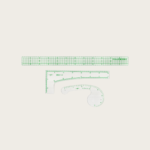 Bunka 1/2 Scaled Pattern Ruler Set
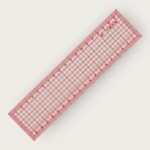 Bunka 20cm Pattern Ruler
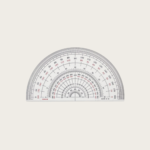 Concise 15cm Half Circle Protractor