
Sewing Tips & Tool Advice
Choosing Pins for Draping and Delicate Fabric
Eight Needles Journal · Small sewing tools
Pins must hold the work while remaining suitable for the fabric. A decorative head, fine-looking shaft or familiar brand does not remove the need to test the actual pin on the material you will use.

Compare the shaft and the head separately
| Pin type | Useful feature | Trade-off to consider |
|---|---|---|
| Small metal-headed draping pin | A low-profile head around folds and closely placed pins | Can be harder to see and pick up. |
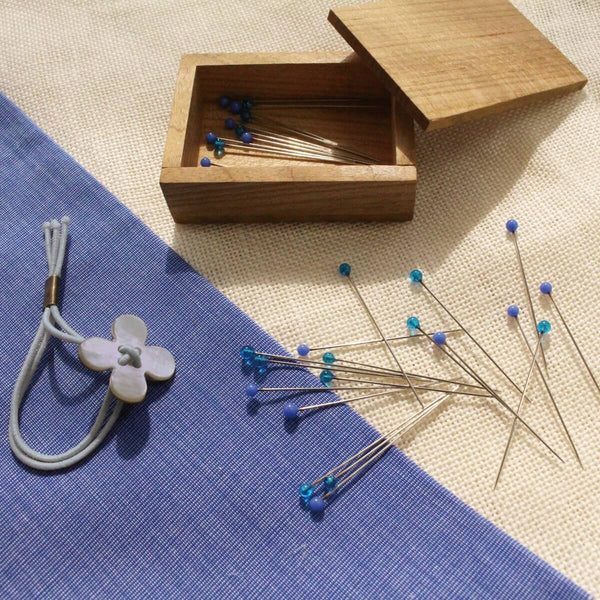
| Glass-headed sewing pin | A visible head that is easy to locate | Head size still affects clearance; check the individual pin’s shaft. |
| Flat-headed pin | A broad head to handle and identify | Head materials vary; do not assume they tolerate heat. |
| Long pin | More reach across a wider area or thicker layers | Extra length can catch surrounding fabric. |
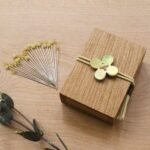
Bunka Silk Pins for Draping are listed at 0.55mm diameter and 30mm long. The name describes their intended use, not a promise that every silk fabric will tolerate them. Cohana’s cherry-wood-box option contains 30 glass-headed pins. Its decorative head and box are useful handling and storage features, but they do not replace checking the shaft against your cloth.
Check the fabric response
Insert a pin into an offcut and remove it. Inspect the surface and weave for an unacceptable hole or snag. Repeat using the layer arrangement needed for the project, especially at areas where the fabric is under tension.
Use the same direction and depth of pinning as the planned construction. Examine the scrap in good light after removing the pin. Where possible, keep test holes and working pins within the seam allowance. If the cloth snags or a hole remains unacceptable, change the pin or holding method before working on a visible panel.
Compare handling
Consider shaft dimensions, head visibility and how easily you can pick up the pin. On a dress form, access differs from work laid flat on a table. Choose the pin that remains manageable in that setting.
For draping, test the combination of pin, fabric and dress form. Do not drive a pin into a hard inner shell. Place pins so you can remove them while supporting the drape, without dragging the cloth across neighbouring points. Recheck the hang after changing the pinning: tension can distort the shape you are trying to assess.
Heat resistance does not prevent pressure marks
Glass heads generally resist heat better than common plastic heads, but check the exact product before pressing nearby. Even a heat-resistant pin can leave an impression under pressure, and metal can become hot. Remove pins from the area being pressed when the construction allows.
Keep the cutting route clear
Remove or reposition pins before they meet scissors or a rotary blade, and remove them before a sewing-machine needle reaches them. Do not assume decorative heads tolerate an iron; check the maker's guidance. Count and contain pins as the work is packed away so none remain hidden in loose fabric.
Choose for a delicate drape
You are pinning a delicate drape. Test the actual pins on an offcut and inspect after removal before using them in visible areas. Head colour can help you find a pin, but it does not establish whether its shaft suits the cloth.
Retire bent, rusty or rough pins rather than mixing them back into the usable supply. A pin that catches the scrap needs attention even when the rest of the packet works well.
Check before choosing
- Does the pin leave an acceptable trace?
- Can I handle it in the working position?
- Is it clear of blades and heat?
Related tools to compare
Compare the size, material and included parts on each product page against the task above.
 Bunka Silk Pins for Draping – 10g
 Cohana-Glass Sewing Pins in Cherry-Wood Box in 5 colours
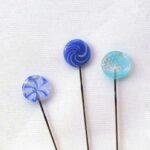 Cohana-Ohajiki Sewing Pins in 4 colours