
Sewing Tips & Tool Advice
Awl or Eyelet Punch: Opening a Gap or Cutting a Hole?
Eight Needles Journal · Punching & finishing
Before choosing an awl or eyelet punch, ask what should happen to the material. Do you need to ease woven threads apart, guide a seam, or remove a small circle? These operations can all involve an opening, but they produce different results.
Choose by the result you need
| Task | Tool to consider | What matters |
|---|---|---|
| Open the weave for trapunto or boutis | Ball-point awl | Separate threads gently and check whether they can settle back |
| Guide delicate fabric or shape a sewn edge | Smooth or curved sewing awl | Contact shape and control, without forcing through the cloth |
| Make a small pierced mark | A suitable pointed or fine awl | Whether a permanent puncture is acceptable |
| Cut a round preparation hole for hardware | Eyelet punch or screw punch | Specified hole diameter, backing and reinforcement |
| Set the hardware after making its hole | The correct setting tool | Compatibility with the exact fitting |
An awl is not one universal point
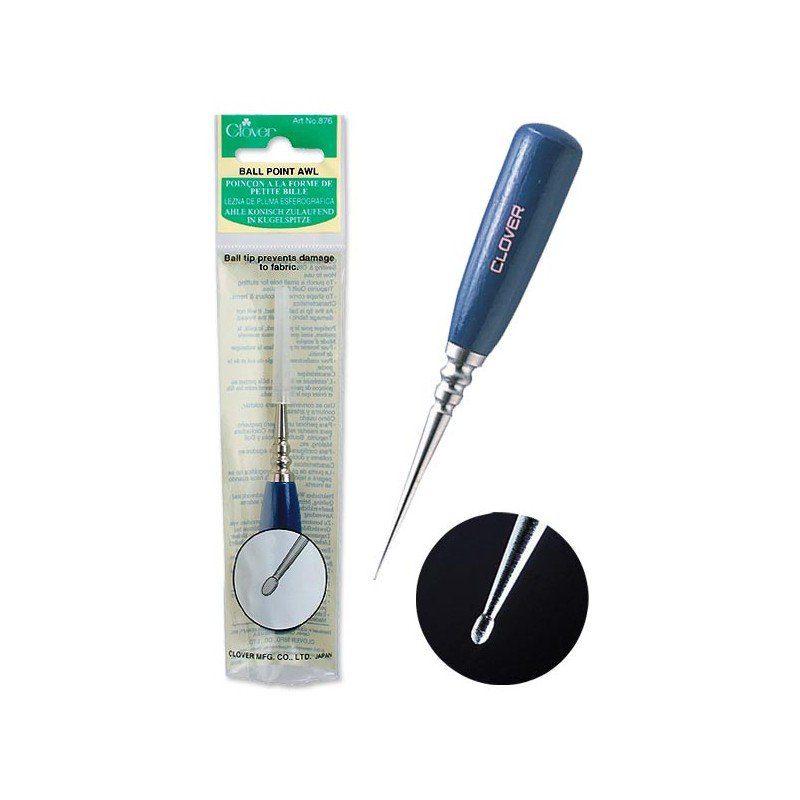
The Clover Ball Point Awl is intended for opening the weave without splitting the thread, including trapunto and boutis work. That makes it relevant when the construction calls for moving threads aside. Test the actual fabric: its rounded tip does not make forceful use harmless.
A smooth sewing awl, such as Clover N Smooth Awl 21-131, is shaped to catch less readily on fibres and sewing thread. It can help with fabric feeding, easing out corners and unpicking. Clover Curved Awl 21-241 offers a different approach for fabric feeding, unpicking and shaping corners. The back of its curve can also help tuck fabric and paper cord into a purse frame.
A fine awl offers different access. Clover N Fine Awl 21-121 has a shaft of consistent thickness towards its base, useful when a small opening needs depth without the widening caused by a strongly tapered shaft. Check the point and task before buying just because a handle looks familiar.
A smooth tip and a rough or damaged tip are also different things. Examine a tool that catches unexpectedly. Do not assume every snag means you need a sharper awl.
A punch removes material
A circular punch cuts a disc out of the work. The Bunka Eyelet Punch provides a 3mm hole; the Nonaka screw punch takes replaceable cutting tips in several diameters. Neither should be substituted for an awl when the instructions require preserving and spreading the weave.

For an eyelet, rivet or snap, follow the fitting’s preparation instructions. Its decorative head is not the hole measurement. Include the specified reinforcement and all intended layers in the sample. A punch prepares the hole; a separate compatible setter installs the fitting.
Two examples that make the choice clearer
A boutis sample needs a small passage in woven fabric. If the technique calls for separating the weave, try the ball-point awl on matching scrap and inspect the threads. Replacing that operation with a 3mm punch removes material the technique may need to retain.
A reinforced bag panel needs a particular eyelet. Use the hole-making method and diameter required for that eyelet. Stretching an undersized opening with an awl is not a reliable substitute for establishing the correct preparation size.
Support the work and inspect both faces
For punching, place a suitable cutting board beneath the actual cutting point. For an awl, support the piece so the point cannot emerge into an unseen hand. Work gradually, inspect both faces and stop if fibres tear or the material distorts.
When using an awl near a sewing machine, keep it clear of the moving needle. It helps guide the material; it should not force fabric through the feed or enter the needle’s path.
Compare these tool types
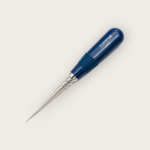 Clover Ball Point Awl
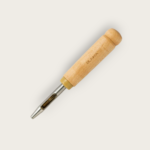 Bunka Eyelet Punch (3mm hole)
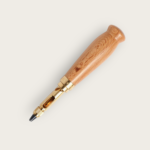 Nonaka Seisakujo Screw Punch with 3mm blade