
No products in the basket.
Guides
Sashiko Needles: Choosing a Length and Checking Pack Contents
Eight Needles Journal · Sashiko
Choose a sashiko needle by how its length works with your hand, thimble and stitch rhythm. A long needle and a medium one can suit different parts of the same project. Start by checking the packet: five of one size and a five-size assortment serve different purposes.

First, understand what is in the packet
Eight Needles has three separate Misuya Chubei sashiko pack formats. Choose by the contents, rather than the number five alone.
| Listing | Contents |
|---|---|
| Choose one size, five-needle pack | Five needles of the selected size, from extra short to extra long |
| Assorted Sashiko Needles, pack of five | One each of extra short, short, medium, long and extra long |
| Long, pack of ten | Ten long needles |
The mixed format is labelled 取合せ in Japanese. It lets you compare lengths, while a single-size packet supplies spares of the needle you already prefer. Check each product page for current availability.
Five lengths to compare
| Size | Japanese label | Length |
|---|---|---|
| Extra short | 特短 | 36.4 mm |
| Short | 短 | 45.5 mm |
| Medium | 中 | 51.5 mm |
| Long | 長 | 54.5 mm |
| Extra long | 特長 | 66.7 mm |
The long needle is 54.5 mm long and 0.96 mm thick, with a grooved oval eye. It is made in Japan for sashiko on cotton cloth. The assorted packet contains one needle of each length above. Length is only one part of the choice: check the eye with your actual thread, too.
A long needle for a longer working section
For a broad line of running stitches, compare a longer needle and see how comfortably it lets you manage the cloth. Include the folded areas in your sample, since a flat single layer tells only part of the story.
Check the thread through the eye before starting the main piece. If threading needs force or damages the yarn, reconsider the combination rather than treating the needle’s length as the only choice.
A medium needle for a different rhythm
A medium needle is worth comparing if a longer one feels awkward against your thimble or needs frequent repositioning. Judge it by a short line of actual stitches, rather than how it feels held in the air.
Similar external dimensions do not guarantee identical eyes or intended uses. Keep the exact needle model with the sample and compare it using the thread planned for the project.
Compare length with your own stitching rhythm
Try a small sample of the project fabric with the actual thread. Stitch a short straight section, then an area where you need to change direction. Notice whether the needle feels easy to position, whether you can guide its point comfortably and whether pulling the threaded eye through the layers requires force.
Do not make the test a competition to load the largest possible number of stitches. The useful choice is the one that lets you maintain the spacing and control you want. Your preferred length for a broad straight section may be different from the one you reach for near a small corner.
Thread choice comes before buying extra needles
Check that the thread passes through the eye without being forced or damaged. Yarn construction, the particular needle and your cloth all matter.
For Daruma thick sashiko thread, choose the long or extra-long Misuya sashiko needle: the extra-short, short and medium options have eyes that are too small for this combination. If you already know which needle works for your project, a packet of that size supplies spares; if you want to compare sizes, buy the clearly identified sizes or a packet explicitly sold as an assortment.
Tools for your next sashiko project
Compare the three pack formats in the table above. The two single-size options are pictured below. The ring thimble is a separate accessory. To compare the appearance of different yarns, see our Daruma sashiko thread guide.
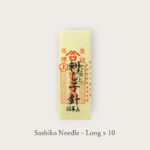 Misuya Chubei – Sashiko Needles – Long (Pack of 10)
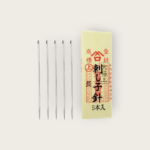 Misuya Chubei Sashiko Needles — Five of Your Selected Size
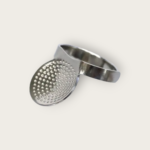 Clover Adjustable Ring Thimble for Sashiko