
Sewing Tips & Tool Advice
Wool Needles: Match the Yarn as Well as the Fabric
Eight Needles Journal · Needles
A needle used with wool needs to suit both the material being joined and the yarn passing through its eye. Fine woven wool and thick knitting yarn present different requirements, even though both projects may be described as wool work.

Joining knitting or sewing wool cloth?
For joining knitted pieces and weaving in ends, a wool or tapestry needle has a roomy eye for yarn. A rounded point helps it travel between stitches without deliberately piercing the yarn. For a seam in woven wool cloth, choose a sharp hand-sewing needle to suit the cloth, sewing thread and number of layers.
This distinction matters when shopping: a needle described as “for extra-thick yarn” is a finishing tool for yarn work. It is not a general recommendation for the thickest wool coat in your wardrobe.
Compare the Misuya Chubei options
| Option | Length × thickness | Packet contents |
|---|---|---|
| Small wool needle | 45.5 × 1.07 mm | 10 small needles |
| Large wool needle | 54.5 × 1.35 mm | 10 large needles |
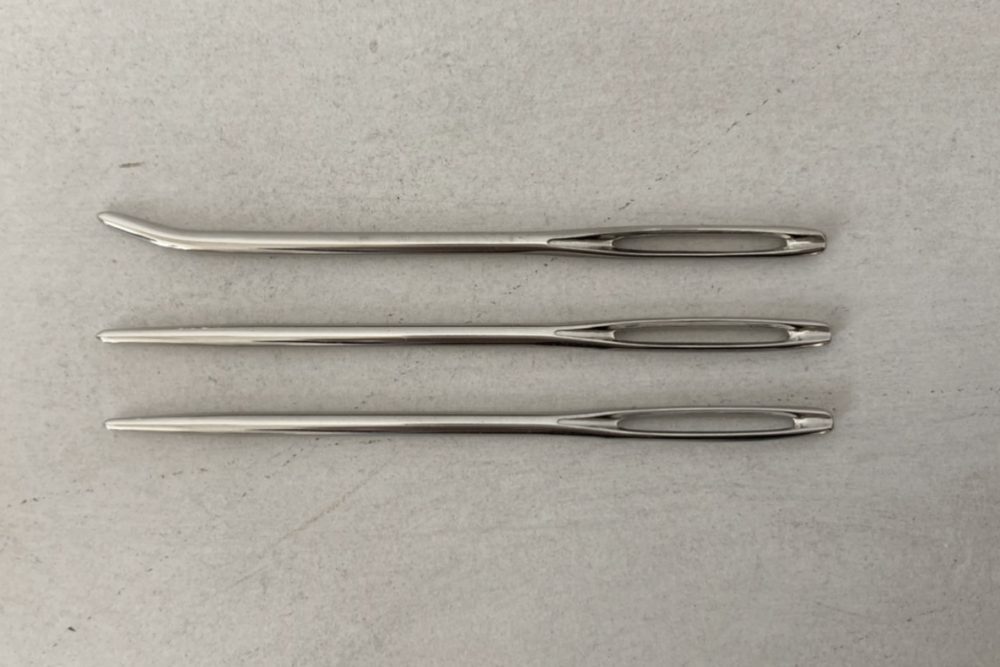
| Extra-thick-yarn set | 70 × 2.4 mm | 3 needles: two straight and one bent-tip |
Small and large have rounded points and grooved oval eyes. The extra-thick-yarn set is a separate product, with a much thicker shaft. These dimensions describe the needles; the numbers are not knitting-needle sizes and do not give the width of the eye opening.
Straight, bent or sharp?
A straight, rounded needle is a useful starting point for following a seam through the loops of knitted fabric. A bent tip can make it easier to reach under a particular stitch or pick up a loop near the surface. Try both with the work supported in your normal position: the useful difference is how comfortably you can see and reach the next stitch.
A sharp-point yarn needle serves a different purpose when the technique calls for splitting a strand. Do not substitute it simply because a rounded tip seems less sharp. First decide whether the stitch should pass between strands or through them.
Check the yarn through the eye
Cut a clean end and thread the actual project yarn. It should move without scraping, shedding fibres or needing to be pulled hard through the eye. A fluffy yarn may need more room than a smooth yarn of a similar apparent thickness.
Then try a few stitches in the swatch. An eye large enough for the yarn can still belong to a shaft that stretches the knitted loops too far. Watch both places: where the yarn passes through the needle and where the needle passes through the work.
Keep the seam as flexible as the knitting
Join a short section using the method in your pattern. Lay it flat and gently stretch it as the finished piece will stretch. Adjust the seam tension if it draws the edges together into a rigid ridge. A bigger needle alone will not correct an overly tight seam.
For weaving in ends, leave enough yarn to follow the chosen finishing method comfortably. Check the front as you work so the finishing thread does not show through. Keep the successful needle with the swatch or note its size on the yarn label; “the large one” becomes less useful as your collection grows.
Compare small and large wool needles · Extra-thick-yarn set · Needles for woven cloth
