
Sewing Tips & Tool Advice
Thread Wax: Check Suitability Before Treating Thread
Eight Needles Journal · Small sewing tools
Thread wax is a treatment to use deliberately, not an automatic step for every sewing thread. Check the product instructions, thread type and finished fabric before deciding whether treatment belongs in your method.
Compare preparation methods
| Option | What changes | Check first |
|---|---|---|
| Untreated hand-sewing thread | No additional coating is introduced. | Whether a shorter working length and a suitable needle already solve the problem. |
| Apply a sewing thread wax | A light coating can help the thread travel through cloth. | The product’s instructions and the sample’s appearance. |
| Use a thread sold pre-waxed | The treatment is already on the thread. | Its intended craft, thickness and finish; leather-sewing thread is not automatically suitable for a garment. |
| Use another thread conditioner | The formulation and application may differ from wax. | Do not transfer instructions between products without checking. |
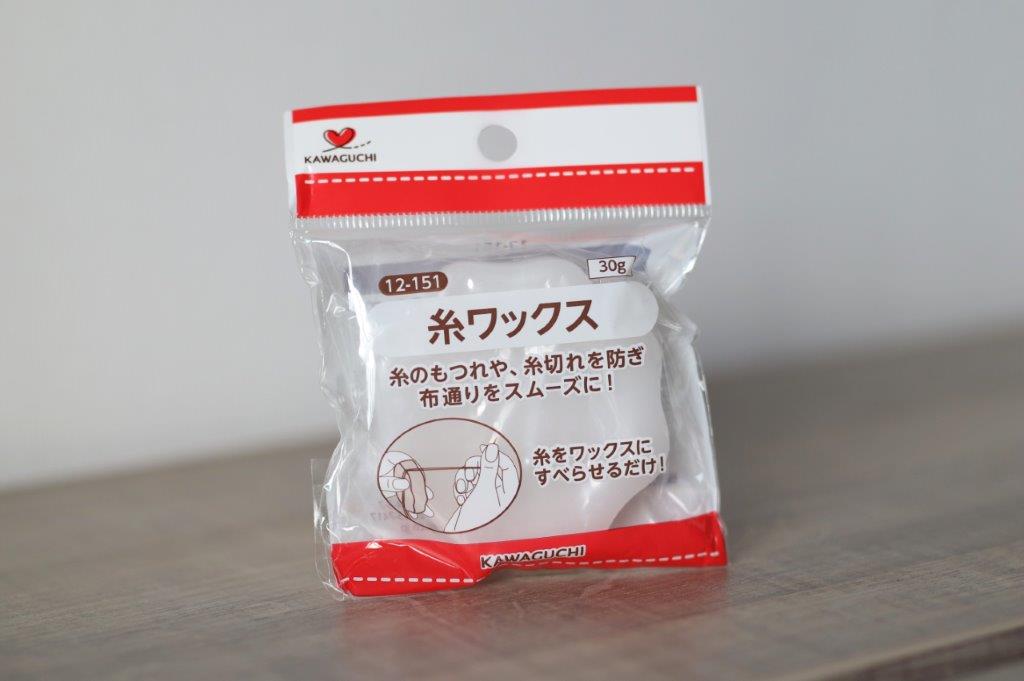
KAWAGUCHI 12-151 is supplied as 30g of thread wax. Clover 57-685 is a thread wax supplied with a holder. Compare how you apply and store them, as well as whether the treatment suits the work. Neither product name establishes that it is pure beeswax.
Begin with the project instructions
Some construction methods call for particular thread preparation. Follow that guidance and the wax maker's directions together. Do not assume that a treatment used in one tailoring task is appropriate for decorative sashiko or a delicate visible seam.
Try a treated and an untreated sample
- Cut two manageable lengths of the same thread.
- Leave one untreated and apply a light, even coating to the other as instructed.
- Sew comparable short sections in matching scraps with the same needle.
- Compare tangling, ease of passage, visible residue and the feel of the finished stitches.
More wax is not necessarily better. Stop if it builds up at the needle eye, leaves a visible deposit or changes the fabric’s appearance. Thread that keeps catching may need a different needle or a shorter working length rather than more treatment.
Test the appearance
Treat a sample as instructed and stitch it through representative cloth. Inspect the thread, fabric and any area where the treatment may transfer. Include the intended care process in the test where appropriate.
Do you need to heat the thread?
Some thread-preparation methods include heat, but this should not be assumed for every wax or fibre. Follow the exact product and construction instructions, and test any permitted heat process before using the treated thread in the garment. Do not apply an unspecified iron temperature simply because another maker used heat successfully.
A hand-sewing treatment also does not establish suitability for machine sewing. Use only thread and treatments approved for the machine and task.
Keep materials identifiable
Label the treated thread or prepare only the amount needed for the task. Store the wax so it does not contact unrelated fabric or supplies. If the sample shows unwanted residue or a changed finish, use an alternative method suited to the project.
Treat only the part of the project that needs it
The construction instructions call for treated thread in one area. Prepare and label only the needed amount, then keep it separate from thread intended for another visible finish. One successful treatment does not establish suitability throughout the project.
Check before choosing
- Does this method call for treatment?
- Have I tested transfer and appearance?
- Can treated and untreated thread be distinguished?
Wax and hand-sewing needles
Choose the needle for the cloth and thread first, then decide whether a treatment helps.
 Kawaguchi Thread Wax 30g
 Misuya Chubei – Hand Sewing Needle for Cotton – Round Eye 丸