
Sewing Tips & Tool Advice
Hasegawa Cutlery: From a Seki Polishing Workshop to the Final Blade Adjustment

Two sharp blades are only the beginning of a pair of scissors. They also have to meet properly. At Hasegawa Cutlery in Seki, that final relationship is adjusted by hand—a small movement at the end of a much longer manufacturing story.
1. From a polishing business to CANARY and HARAC
Hasegawa Cutlery began with polishing. Its own history records 長谷川俊一 starting a grinding and polishing business in Seki in 1933, before the company began making scissors in 1945. That beginning gives the work of adjusting a finished blade a particular place in its story. The business incorporated in 1949, added factories and began producing cast-iron pinking shears in 1953. CANARY was registered as a trademark in 1956. A move to the Hidase site in Seki followed in 1984, together with the present company name.
Later developments included the Dan-chan cardboard cutter in 1993 and the HARAC trademark in 2004. The company chronology records three generations of leadership, with 長谷川尚彦 taking over in 2011. Hasegawa’s company history.
2. The last adjustment is made by hand
Hasegawa says it carries out most manufacturing stages in its own factory. Its illustrated process moves from pressing steel blanks and heat treatment to grinding, polishing, inspection and assembly. The exact sequence depends on the type of tool; the illustrated resin-handle stage is not a description of every Cohana model.
At the stage called shigumi, a craftsperson adjusts how the two blades engage. This is distinct from simply giving each blade a sharp edge. The factory account also identifies manual inspection for small surface defects before final packing. The illustrated manufacturing process.


The photographs make a useful distinction between the shape of a blade and a finished pair of scissors. A blank has an outline; it still needs the work that creates an edge and a pair that closes correctly. It is easy to recognise the finished object too early when looking at manufacturing photographs. Following several stages helps you see how much is still to happen.


3. Developing for different hands and tasks
The company’s quality statement describes listening to users during development. It links the Dan-chan range to demand for a blade suited to opening packaging, and identifies universal design as central to HARAC. Its range extends across office, craft, household and specialist cutting tools. Hasegawa’s development approach.
Explore this part of the story: Cohana-Seki Mini Scissors with Leather Pouch – 9th Anniversary Limited Edition.
4. The Cohana connection
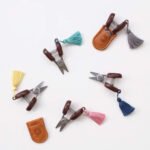
Cohana identifies Hasegawa as the maker of its Seki Mini Scissors. MARIMO makes the silk tassel. The miniature pinch-action tool is one collaboration within Hasegawa’s broader business, and the category below brings together the mini-scissor formats listed by Eight Needles. Cohana’s producer information.
The Cohana Seki Mini Scissors bring this manufacturer into a very small space. Their pinch action gives them a different shape from conventional finger-loop scissors, and the tassel adds work from another maker. In Cohana’s account, the tassel is made by MARIMO in Fukuoka. The finished object therefore joins a blade-making story with a textile one. Cohana’s producer account.
Compare the miniature scissors with the factory photographs above. The scale has changed, but the question about how the blades meet remains. That is the detail to carry away from this maker story: the cut depends on the relationship between the two parts, as well as the sharpness of each one.
5. Explore the collection by category
Explore by category
Cohana Seki Mini Scissors and combinations
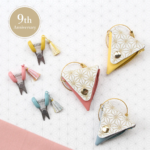 Cohana-Seki Mini Scissors with Leather Pouch – 9th Anniversary Limited EditionView details & options →
Words: Eight Needles. Historical, workshop and product images are credited in their captions. Company and manufacturing sources are linked beside the relevant passages. Historical and manufacturing sources are linked beside the relevant passages. Product links open the live Eight Needles shop.
