
No products in the basket.
Guides
Paperweights at the Pattern Table: What Matters?
Eight Needles Journal · Patternmaking
A paperweight earns its place at the pattern table by holding a sheet where you need it, while leaving room to work. Cohana’s button-shaped Nambu iron weight adds a regional craft story to that everyday job—but its surface needs to be treated with care.
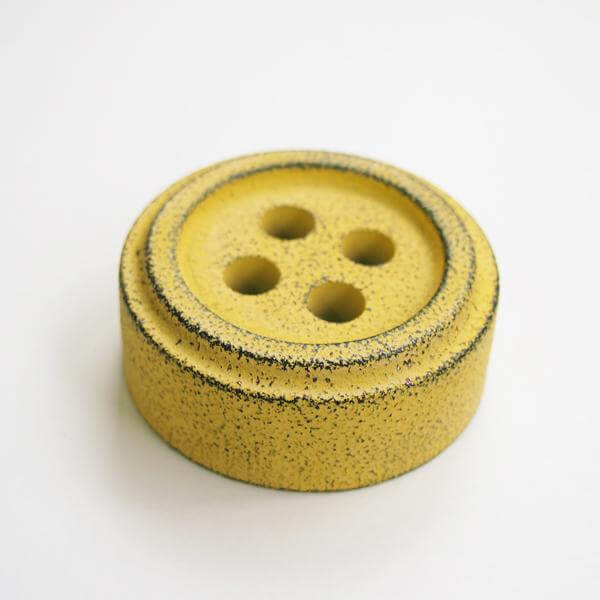
A button shape from an Iwate foundry
According to Cohana’s official product story, the Nambu iron paperweight is made by the foundry 及精鋳造所 in Mizusawa, Oshu, Iwate. The foundry began operating in 1916. The design turns a familiar sewing button into a cast-iron object: its holes can hold pens, and the weights can be stacked for storage.
Cohana lists an approximate weight of 360g, a diameter of 60mm and a height of 23mm. These measurements describe the standard product on the linked page, not every limited edition or other button-shaped weight.
From the foundry to the pattern table
The cast surface begins with a mould and molten iron. We find that connection part of the paperweight’s appeal: an everyday sewing-room object carries the work of a foundry in Mizusawa, Iwate.


The important handling detail
Cohana says not to place or slide this weight directly on fabric. Friction can damage cloth or transfer colour. The maker also warns that twisting stacked weights against each other can wear or transfer the finish. Avoid impacts and damp storage. Read these handling notes alongside the attractive product photographs.
For pattern work, arrange the job so the weight bears on the paper rather than exposed cloth. If your intended method requires direct contact with fabric, choose a holder explicitly suited to that use and follow its own instructions. A decorative desk weight and a fabric-cutting weight should not be assumed interchangeable.
Think about the shape of the pattern piece
Before adding weights, look at where the paper wants to lift or move. A long narrow strip needs a different arrangement from a broad bodice piece. Plan enough access to read the markings, align the pattern and reach the area you are working on.
Try the arrangement on an uncut paper copy first. If moving your ruler makes you repeatedly lift and replace the weight, consider changing its position. The most useful setup is one that supports the sequence of work, not simply the one with the heaviest object in the middle.
Our idea of a useful pattern-table setup
We would keep the weight close to the ruler and pencil, with a clear space for the paper pattern. Choose the positions around the shape you are drawing, leaving the important markings and working edge visible. The weight should make the layout easier to manage without getting in the way.
That combination is a useful prompt for your own table. Decide what needs to stay within reach and what can be put away. A compact set of tools that works comfortably around the paper can be more useful than filling every free space.
Storage is part of the choice
If the table is shared with other activities, consider where the weight will live after the sewing session. Keep it somewhere stable, where it cannot roll or fall onto delicate tools. Clear the work surface before putting a new project down; a tidy arrangement from yesterday can still conceal thread ends or small scraps.
When comparing two weights online, check the actual dimensions and material rather than judging by photographs alone. A large close-up may make a compact object look much bigger than it is. The stated weight is useful, but it does not describe the contact surface or tell you how much of your pattern it will cover.
Compare holders for your pattern table
The listings below include the Cohana Nambu weight and other holders. Each has its own construction and handling instructions. Choose for the surface and task you intend to use it on.
 Cohana-Nambu Iron Paperweight in 6 colours
 Cohana-Yuzen Leather Paperweight in 2 colours
 Bunka Pattern/Fabric Weight – Gelato Pastels in 5 options
Explore the Eight Needles Journal
Sources and further reading
Cohana: foundry photographs and background
Product information and background reading used in preparing this guide.
