
No products in the basket.
Guides
Beading Needles: Check the Bead Hole Before Buying
Eight Needles Journal · Needles
A beading needle has to pass through the bead with the thread, sometimes more than once. The bead's hole and your stitch path matter as much as the needle's length. Test the complete combination before beginning a repeated design.
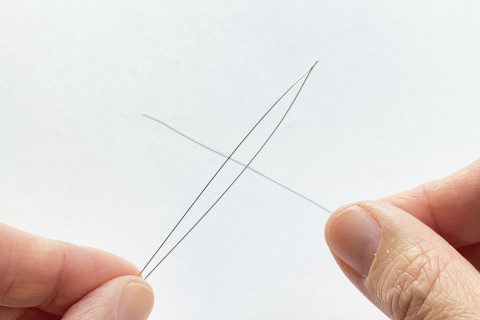
Two needle types, two different jobs
| Tool | Dimensions and contents | What to check |
|---|---|---|
| Misuya Chubei beading needle | 48.5 mm long, 0.41 mm thick; 10 needles | Conventional grooved eye; fine needle for bead embroidery |
| Kawaguchi big-eye needle | 60 mm or 100 mm; 2 needles of the chosen length | Long opening for threading; intended for bead stringing, with an unsharpened end |
The Misuya needle is plated and made in Japan. Its 0.41 mm measurement is the shaft thickness, not a promise that every bead with a hole of that size will pass over the threaded eye. The Kawaguchi tool makes threading easier, but it is not a sharp hand-sewing needle for piercing cloth.
Count every pass through the bead
Read the stitch path before choosing the needle. In beadwork, a single bead may carry the first thread, a return pass and later reinforcement. Each pass takes up more of the space inside the hole.
Test several beads from the actual batch with the intended thread. Follow the full route, including the final return pass. Do not stop the test after pushing an empty needle through one bead: the eye with thread around it is the part that must also pass.
Match the point to the technique
Bead embroidery on cloth needs a point that can penetrate the foundation cleanly. Bead weaving follows existing thread paths through holes; a slightly rounded point can help avoid splitting a thread already inside. Read the particular needle’s description, because “beading needle” covers more than one point shape.
A big-eye stringing needle solves a threading problem. Before replacing a conventional needle with it, check both the bead hole and the work: a tool that strings loose beads comfortably may be unsuitable for stitching them to a tightly woven foundation.
Length changes reach and control
A longer needle offers room to pick up a run of beads. A shorter needle can be easier to turn through a small motif or use near the end of a thread. Compare length and thickness separately; the longer product in a range is not always the finer one.
If you work with several bead sizes, keep the successful needle and thread combination with a small labelled sample. Record the bead type and number of passes as well as the needle. That makes the next matching project much easier to set up.
When the needle stops halfway
Stop at resistance. Forcing or twisting a needle through a crowded hole can break the bead or needle and damage the existing thread. Withdraw gently if possible, set aside an unusually tight bead, and reassess the combination.
Check whether the obstruction is at the eye, whether several strands already fill the hole, and whether the bead has a visibly narrow opening. A finer needle may help, but a change of thread or bead may be necessary. Check the pattern before changing the thread, since it also contributes to the structure of the finished piece.
