
No products in the basket.
Guides
Long or Short Hand-Sewing Needles?
Eight Needles Journal · Needles
Needle length changes your control and stitching rhythm; it does not tell you the needle’s thickness. Start with a type that suits the cloth and thread, then compare lengths within that range.
What changes when the needle gets longer?
A longer needle gives your fingers more shaft to hold and can suit a sequence of running stitches. A shorter needle can feel easier to turn in a small area. Neither advantage is absolute: your grip, stitch size and use of a thimble all affect the result.
For example, the needle that feels comfortable along a straight hem may be awkward when closing a small opening. It is reasonable to change lengths for those two stages, even though the fabric and thread stay the same.
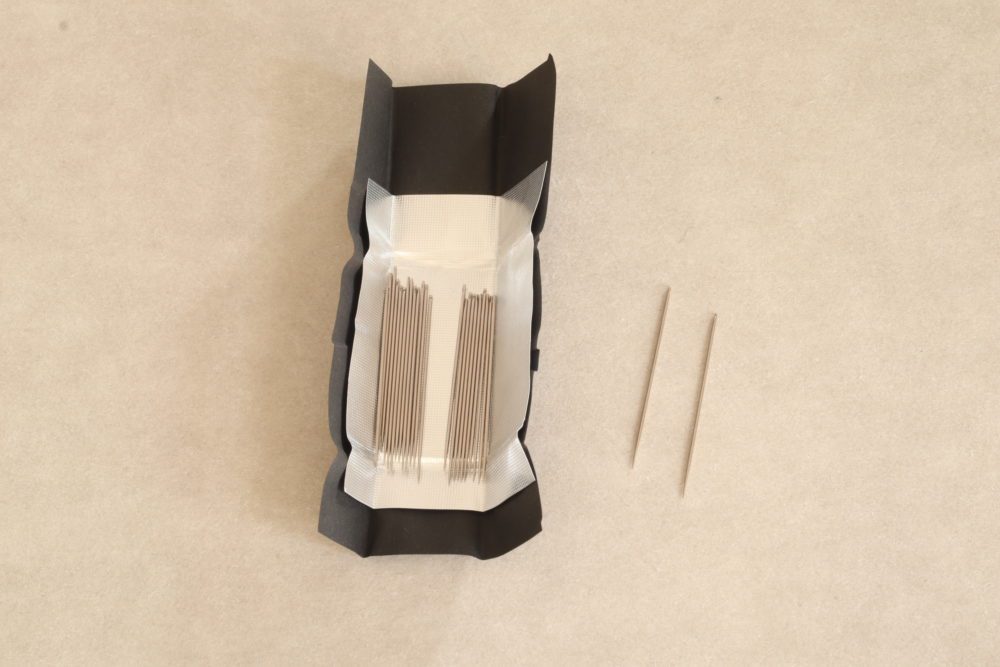
Sōho long and short needles: compare the same number
The Sōho long range and Sōho short range each offer No. 4 to No. 9. Match the number when you want to compare length while keeping the listed thickness the same.
| Sōho size | Short length | Long length |
|---|---|---|
| No. 4 | 34.8 mm | 42.4 mm |
| No. 5 | 33.3 mm | 40.9 mm |
| No. 6 | 31.8 mm | 39.4 mm |
| No. 7 | 30.3 mm | 37.9 mm |
| No. 8 | 28.8 mm | 36.4 mm |
| No. 9 | 27.3 mm | 34.8 mm |
Each listing is for a packet of 25 needles in the selected size. The range in the title does not mean that every packet contains all six numbers.
Do not carry one numbering rule into every range
In the Sōho range above, moving from No. 4 towards No. 9 changes both thickness and length. In the Misuya Chubei silk range, the examples below share a 0.56 mm thickness while the second part of the name indicates a different length.
- Four-one, 四ノ一: 33.3 mm long.
- Four-three, 四ノ三: 39.4 mm long.
- Four-five, 四ノ五: 45.5 mm long.
Those are examples from the Misuya Chubei silk needle range, not a universal translation of needle numbers. Read the dimensions and selected option rather than assuming that a higher number always means a longer needle.
A useful comparison takes only a short sample
Keep the cloth, thread and needle family consistent. Sew a straight section with each candidate, then a few stitches in a confined area. Use your normal grip and thimble so that the test reflects the way you actually work.
Notice where your fingers sit and how often you have to reposition them. Can you place the point precisely? Can you turn the needle without pulling the fabric out of shape? If you take several running stitches at once, can you still bring the loaded needle through comfortably?
Loading more stitches is not useful if it makes the needle difficult to draw through. Reduce the number of stitches at thick junctions and change the method when needed.
Let the stitch decide
Choose a shorter or medium length as a starting point for compact sewing and buttons; compare a longer option for hemming or a running-stitch rhythm that benefits from it. Then keep the length that gives you comfortable control on the actual project.
If the needle is difficult to push or the thread struggles to follow it, revisit needle thickness and thread choice. Length alone will not solve an unsuitable fabric-and-thread combination.
