
Sewing Tips & Tool Advice
Round and Grooved Needle Eyes: What to Compare
Eight Needles Journal · Hand sewing
On Misuya Chubei needle packets, 丸 and 溝 refer to different eye shapes. That small detail can matter when you thread the needle, but it does not tell you the needle’s length or thickness. Here is how to read the choice without mixing those three things together.

Maru and mizo: read the eye separately
Maru (丸) means a round eye; mizo (溝) means an elongated eye. Both are offered within parts of the Misuya Chubei range. A round eye can be quite small, while an elongated opening may feel more familiar to thread. Choose with your actual thread in hand: the shape name does not specify the size of the opening.
Do not interpret “grooved” as the needle’s overall size. A grooved-eye cotton needle still needs to be matched to the cloth and thread, just as a round-eye one does.
Threading is part of the choice
Check how comfortably you can thread the needle before judging its feel in the cloth. The eye, thread thickness and available light all matter during that first step.
A needle that suits the stitch still needs to be practical to prepare. Choose the eye form that works with the actual thread, while keeping length and thickness as separate decisions.
The numbers are another part of the label
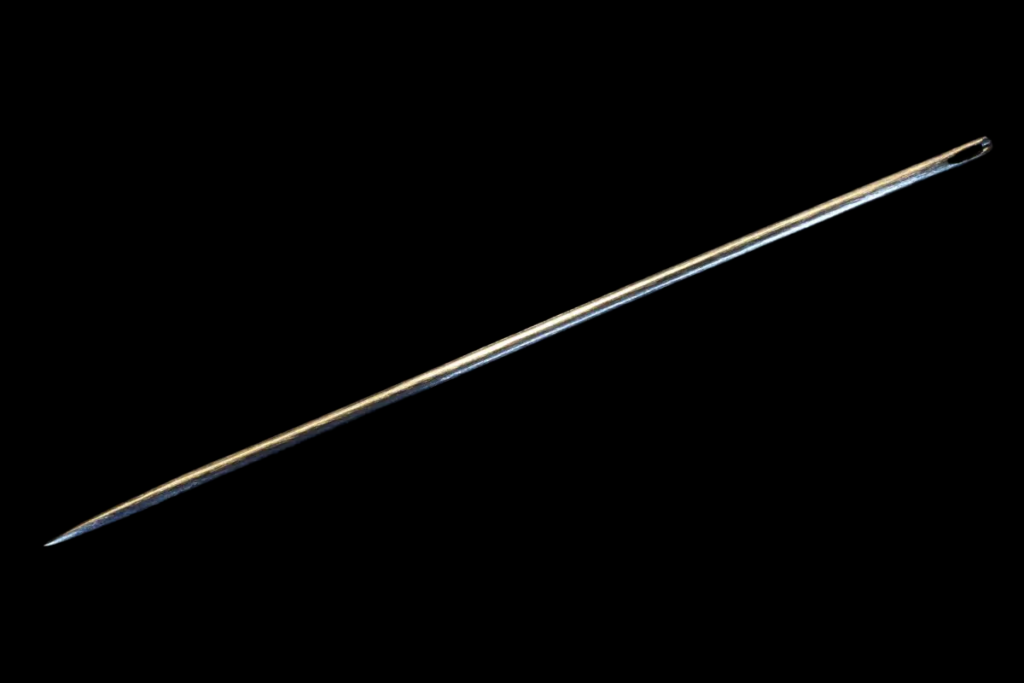
The Misuya Chubei cotton range includes three-one through three-five. All five below are 0.71 mm thick, while their lengths differ:
| Cotton needle | Length | Thickness |
|---|---|---|
| 三ノ一 · 3-1 | 33.3mm | 0.71mm |
| 三ノ二 · 3-2 | 36.4mm | 0.71mm |
| 三ノ三 · 3-3 | 39.4mm | 0.71mm |
| 三ノ四 · 3-4 | 42.4mm | 0.71mm |
| 三ノ五 · 3-5 | 45.5mm | 0.71mm |
Within this cotton range, the second number increases with length. Each standard packet contains 25 needles of one selected length. It does not contain all five lengths. An assortment is a separately identified product.
Start with the needles your project needs
For a first selection, choose a small number of clearly labelled needles suited to the cloth and stitches ahead. Keep their packets so a favourite combination is easy to identify and reorder.
Check the complete maker name as well as the word Misuya. Different Kyoto businesses use that name. The needles discussed here are Misuya Chubei; dimensions and pack contents should match that exact range.
Check the threader separately
A threader that fits one elongated eye may not fit a small round eye. Check the supported eye shapes and needle sizes for the exact threader, including whether it takes your thread thickness. Do not force a wire loop or mechanical hook through a tight opening.
Threading success is not the final test. The eye and the doubled thread must also pass comfortably through the fabric. If that part catches repeatedly, review the thread and needle combination rather than selecting an even larger eye automatically.
Make a useful comparison at home
If you want to compare eye shapes, use the same needle size where both versions are offered. Keep the thread and sample cloth the same too. Otherwise, a change in length or thickness can be mistaken for an effect of the eye.
Notice three things separately: whether you can thread it comfortably, how the threaded eye passes through the actual layers, and whether the needle length suits the stitch you are making. Keep the chosen packet beside the sample and note the size and eye form. Those notes make the next purchase much easier.
Compare the labelled options
Below are our round-eye and grooved-eye cotton listings, followed by a separate grooved-eye assortment. Check the selected size and pack contents on the product page before ordering. For choosing the needle around the cloth, read our hand-sewing needle guide.
 Misuya Chubei – Hand Sewing Needle for Cotton – Round Eye 丸
 Misuya Chubei – Hand Sewing Needle for Cotton – Grooved Eye 溝
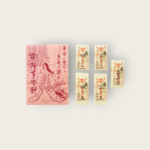 Misuya Chubei – Assorted popular needles (Grooved oval eye)