No products in the basket.
Guides
20cm, 50cm or 60cm: Which Pattern Ruler?
Eight Needles Journal · Measuring
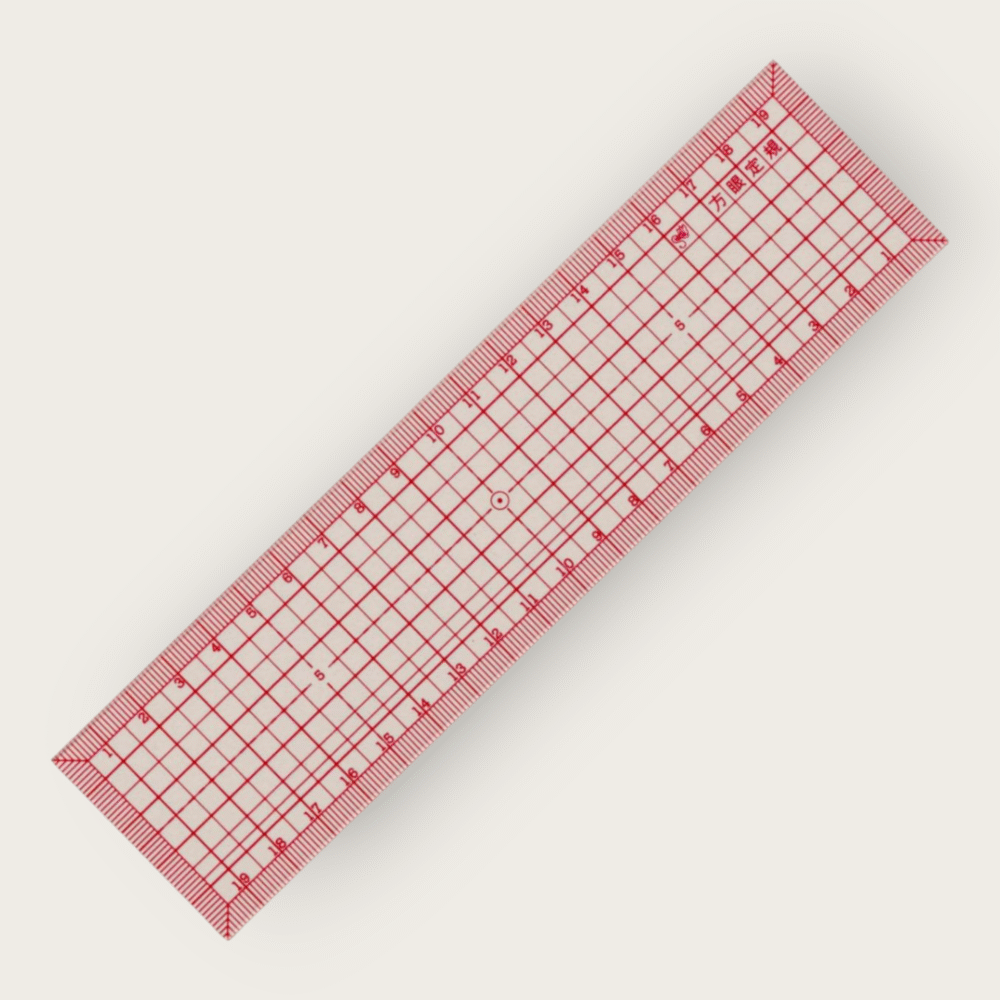
The right ruler length depends on the space around your pattern as much as the pattern itself. A compact ruler is easy to turn around small details; a longer one bridges more of a grainline or garment panel without being repositioned.
Match the working area
Measure the clear space on your table before choosing a long ruler. If its end hangs unsupported, it becomes harder to keep flat. A shorter ruler can be more comfortable for cuffs, pockets and checking small distances between markings.
Avoid accumulated errors
When a line is longer than the ruler, make an overlapping reference rather than repeatedly marking from the previous endpoint. Check the completed line against the pattern instructions. Tiny alignment errors can add up when a measurement is built from many separate sections.
A two-ruler arrangement
For a compact dressmaking setup, keep a short ruler near the machine and a longer one at the pattern table. You do not need every length. Choose the second ruler only when it solves a repeated difficulty, such as a long centre line or an awkwardly small pocket corner.
A practical example
A pocket piece and a full-length trouser panel do not need the same working reach. Use a compact ruler to check the pocket's short edges, then move to the longer ruler for the panel's reference line. Keep the smaller tool rather than replacing it simply because the project is larger.
Check before choosing
- Will it lie flat on my table?
- Are the units the ones in my pattern?
- Does my current ruler already cover this job?
Related tools to compare
Compare the size, material and included parts on each product page against the task above.
 Bunka 20cm Pattern Ruler
 (NEW) Bunka 50cm Pattern Ruler
 (NEW) Bunka 60cm Pattern Ruler
Meet the maker
For the company background, workshop photographs and more of the range, read Bunka: The People, Classrooms and Tools Behind a Century of Making Clothes.