
Sewing Tips & Tool Advice
Naturally Dyed Thread: Choosing Colour with Care
Eight Needles Journal · Thread and colour
Choosing naturally dyed thread begins with colour, but it does not end there. NONA’s fine thread and its thicker embroidery thread create different lines on cloth. Knowing which you are buying makes a palette more useful—and helps you plan enough thread for the project.

Fine thread and NONA thread are different weights
NONA Fine Thread and NONA Thread are both cotton, but produce different line weights. The comparison with DMC No.25 floss below is approximate:
| Thread | Approximate thickness comparison | Typical length |
|---|---|---|
| NONA Fine Thread | Approximately one strand of DMC No.25 | Approximately 140m |
| NONA Thread | Approximately three strands of DMC No.25 | Approximately 12.5m skein |
| NONA Card Thread | The thicker NONA Thread, wound on a card | Approximately 40m |
This is a comparison of thickness, not a claim that NONA thread is DMC floss or that it should be separated into the same number of strands. In temari, the fine thread is used for the foundation and the thicker thread for the patterned stitching.
Choose the line weight before the palette
For delicate embroidery, begin by comparing the fine thread against the line weight you normally enjoy. For a more pronounced stitched surface, include the thicker NONA thread in the sample. The colours are inviting, but the thickness changes the result as much as the shade.
Try a small area of satin stitch and a simple running line. Keep the cloth and colour contrast similar, then compare coverage, spacing and the way the thread sits on the surface.
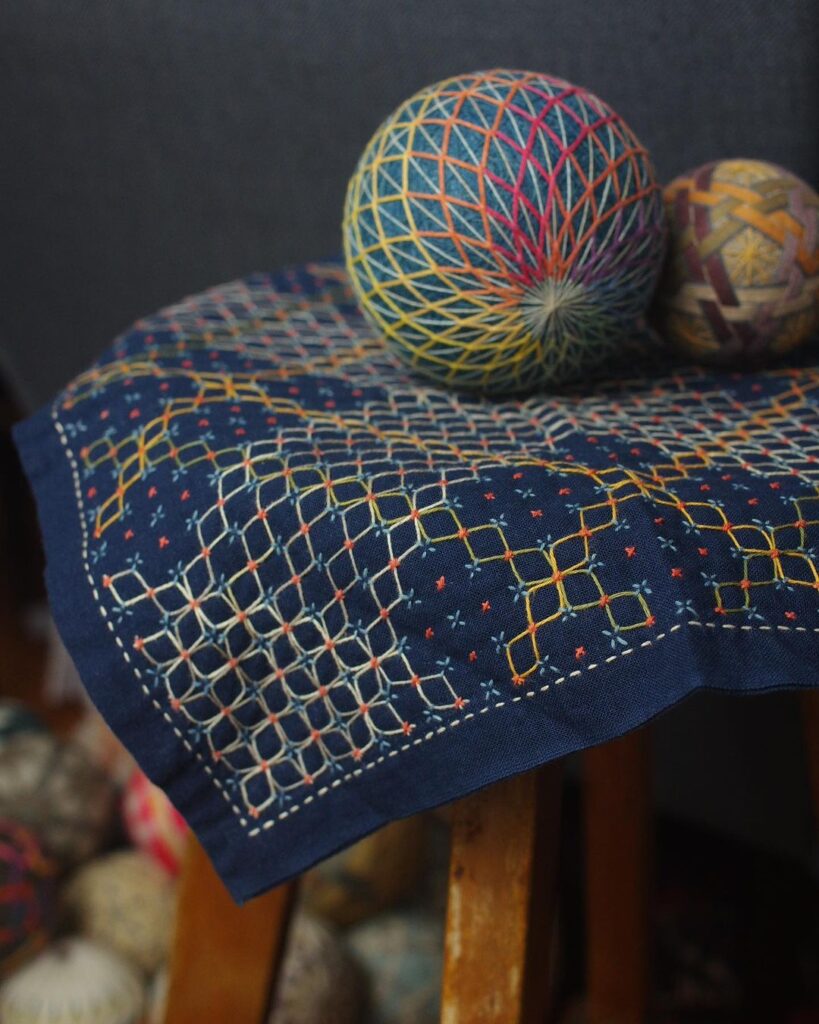
Colour and line work together in sashiko
A geometric motif lets colour travel through straight sections and turns. A small sample lets you see how a delicate line behaves at an intersection before committing to a whole cloth.
That gives you a useful way to plan a sample: choose a part of your pattern containing both a straight line and a corner. Compare how clearly the thread shows against the cloth, and how dense the design looks when the lines meet. You may want a delicate line for one motif and a stronger one for another.
Buy enough of a colour you want to repeat
Colours can vary between dye lots, and dye materials may change with the season. Plan the quantity around the work you intend to make. Do not assume a later purchase will match an earlier colour exactly.
Keep the original labels with your thread. If you are planning a matched pair or a design with one continuous background colour, decide on the quantity before starting. For a deliberately varied palette, a change of shade may be welcome—but it should be a design choice you can see on your sample.
Care for the colour after stitching
Use neutral detergent, wash and rinse separately by hand, and dry in the shade. Keep the thread away from direct sunlight in storage. Dark colours can transfer. A small stitched and washed sample is useful before combining a dark thread with pale cloth for a large project.
Natural dyeing does not itself establish organic certification, guaranteed colourfastness or suitability for every use. Follow the care instructions for the actual thread and the fabric you combine it with.
Make one sample to keep and one to wash
Stitch two small samples with the same thread and cloth. Keep one untreated as a reference and wash the other using the care method intended for the finished piece. Let it dry completely before comparing the colour and checking the surrounding fabric for transfer.
Record the detergent and method with the thread label. A successful trial applies to that combination; it does not establish that another colour will behave identically. Avoid experimenting with bleach or strongly alkaline cleaners on the finished work.
What is in the Eight Needles boxed selection?
Our NONA Naturally Hand-Dyed Thread Set is listed with nine colours of Fine Thread at approximately 140m each, plus four colours of the thicker Card Thread at 40m each, in a woven box. That combination offers two line weights. It is not thirteen identical skeins, and it should not be confused with another NONA gift box containing a different selection.
Check the current product photographs and contents before ordering. For storage ideas, our sewing-tool storage guide compares small Cohana containers, a tool roll and a larger bag.
