
No products in the basket.
Guides
Shozaburo: The Scissor Maker, the Tailor and the Iga Braider

A name on a blade. A pair kept by a tailor for years. Silk braid wrapped around a small set of snips. Shozaburo’s story can be followed through objects and the people who make, maintain and use them.
1. A name attached to a making tradition
Shozaburo’s shears carry the name of a scissor maker, 三浦庄三郎. A surviving commemorative pair gives that history a tangible form: sewing wholesaler Nippon Chuko records receiving a pair made by him for the business’s sixtieth anniversary, with the occasion marked on both the blade and its box. Nippon Chuko’s account of the pair it received. Cohana’s account of its collaboration traces the inherited scissor-making techniques back through the nineteenth-century work of swordsmith Yoshida Yajuro. It describes Shozaburo’s craftspeople continuing that technical lineage. This is a history of the craft being passed on, distinct from a company incorporation date. Cohana’s Shozaburo feature.
2. Two makers meet in one pair of snips
The Cohana version combines Shozaburo’s snips with braid from Matsushima Kumihimo in Iga. Cohana identifies the braid maker as 松島俊策 and describes repeated colour trials against the darkened steel. The braid is wound around each pair by hand, with a brass button completing the handle detail. The collaboration and its makers.


Look at the braiding photograph again. The finished grip hides most of that arrangement of threads. It is the same kind of before-and-after that makes a blade-making photograph interesting: a process with its own tools becomes a compact detail in something used every day.
The collaboration offers two ways to appreciate the snips. Follow the steel back to Shozaburo, or follow the colour and wrapping back to Matsushima Kumihimo. Both routes arrive at the same small object. The official film linked here belongs to Cohana’s account of that collaboration.
3. A tailor’s long-used tools
In a published interview, Ginza Tailor’s head cutter Nakayama showed two Shozaburo pairs: one for paper patterns and one for cloth. He described using them for more than twenty years with repeated maintenance. That is one named tailor’s experience, rather than a promised lifespan for every pair. PLUS’s interview with Ginza Tailor.
Explore this part of the story: Shozaburo Tailor Slim Light Model 24cm (Right-handed).
The tailor’s account gives an everyday setting to the maker story. One pair for paper and another for cloth is an easily understood working habit: each tool has a recognisable job. It also reminds us that ownership has a history. Sharpening, adjustment and the way a pair is used become part of its life after it leaves the maker.
Long tailor’s shears and short thread snips sit at different moments in the same project. One helps turn the pattern into pieces of cloth; the other comes close to a seam to deal with a thread. Their forms make more sense together when you follow the garment from cutting out to finishing.

4. The models in the Eight Needles collection
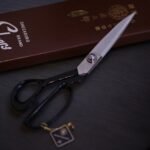
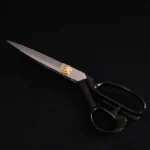
Our categories include tailor’s shears, short- and long-blade 105mm snippers, and the Cohana collaboration. Standard, Slim Light and Deluxe titles identify different models. The photographs and model names keep those differences visible after the maker story.
The categories below separate tailor’s shears, 105mm snippers and the Cohana collaboration. Within the tailor’s shears, keep the model names and sizes in view. Within the snippers, compare the short and long blade forms. Begin with the work your hand needs to do, then choose the version that fits it.
5. Explore the collection by category
Explore by category
Tailor’s shears
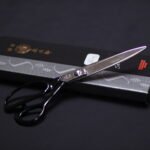 Shozaburo Tailor Slim Light Model 24cm (Right-handed)View details & options →
Thread snippers
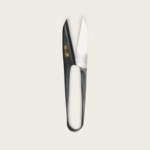
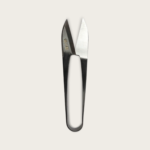 Shozaburo 105mm Snippers -Short BladeView details & options →
Browse 1 more in this category
Cohana collaboration
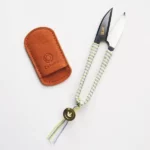 Cohana-Shozaburo Thread Snips with Iga Silk Braid in 4 coloursView details & options →
Words: Eight Needles. Historical, workshop and product images are credited in their captions. Company and manufacturing sources are linked beside the relevant passages. Historical and manufacturing sources are linked beside the relevant passages. Product links open the live Eight Needles shop.
